CNN 009
· 약 2분

Prediciting Bounding Boxes
- Using:
- Sliding Window (Slow)
- Selective Search
- Region Proposals
- Task:
- Predict Bouding boxes from CNN
Non Maxima Suppression (NMS)
- Check the probabilities of each detection and keep ones with score above a certain threshold (0.7)
- For remaining boxes,
a. Box with highest score is the detection results.
b. Discard any remaining boxes with
IoU > 0.5with final detected box c. i.e. overlap with the box with highest score.
Anchor Boxes
- Associate each object to:
- A cell which contains its mid-point and
- Anchor box for the cell with highest IoU
- Calculate the IoU of Anchor boxes and prediected Bounding Boxes.
-
- is objectness score
- are the coordinates of the center of the bounding box relative to
- are the height and width of the bounding box
- are the class information for the object in the bounding box
YOLO
- Real-time performance with 45 FPS, 0.02 sec per image
- Not suitable for small objects
- Issues with new or multiple aspect ratios and unable to generalize
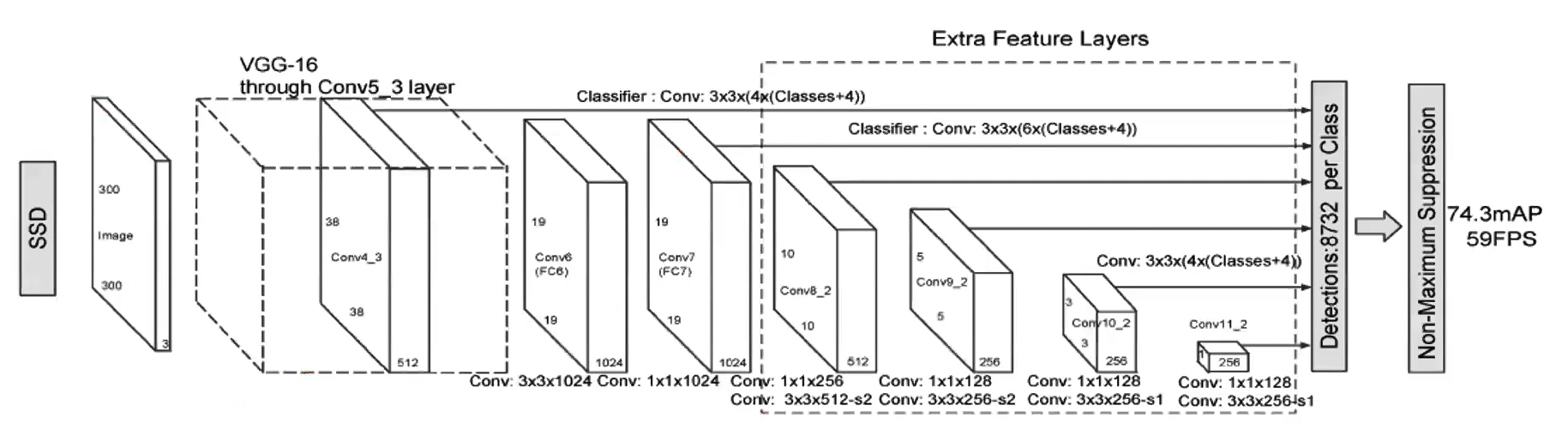
SSD, Single Shot Detector
- Similar to YOLO, VGG16 base Convolutional Neural Network layers
- Take advantage of Anchor boxes with different aspect ratios
- Large number of anchors boxes are chosen
- Not suitable for small objects
- 3 times faster than Faster R-CNN
- with ResNet-101 base SSD may help in detecting small objects with better features from the CONV layers
Overview of Object Detection
- Base Networks
- VGG156
- ResNet-101
- Inception-v2, v3
- ResNet
- MobileNet
- Alexnet
- ZFNet
- Object Detection Framework
- R-CNN family
- YOLO family
- SSD family
- F-RCNN family
- Faster-RCNN is more accurate but slower
- YOLO/SSD are faster/real-time but may not be very accurate