Policy Search Methods
Instead of V V V Q Q Q
π θ ( a ∣ s ) ≈ P ( a ∣ s , θ ) \pi^{\theta}(a|s) \approx P(a|s, \theta) π θ ( a ∣ s ) ≈ P ( a ∣ s , θ )
Policy was generated directly from the value function (e.g. ϵ \epsilon ϵ
Parameterize the policy directly.
Instead of v ( s , w ) v(s,w) v ( s , w ) q ^ ( s , a , w ) \hat{q}(s,a,w) q ^ ( s , a , w ) π θ ( a ∣ s ) \pi^{\theta}(a|s) π θ ( a ∣ s )
Given a particular state s s s
θ \theta θ
Value-based and Policy-based Methods
Value-based: Learnt value function, Implicit policy (e.g. ϵ \epsilon ϵ
Policy-based: No value function, Learnt policy.
Good convergence properties
Effective in high-dimensional or continuous action spaces
if it is really continuous and large, it is not efficient as well.
Can learn stochastic policies.
Sometimes policies are relatively simple, values and models are complex.
Typically reaches local optima.
Obtained knowledge is specific and does not generalize well.
Actor-Critic: Learnt value function, Learnt policy.
Policy Gradient Techniques
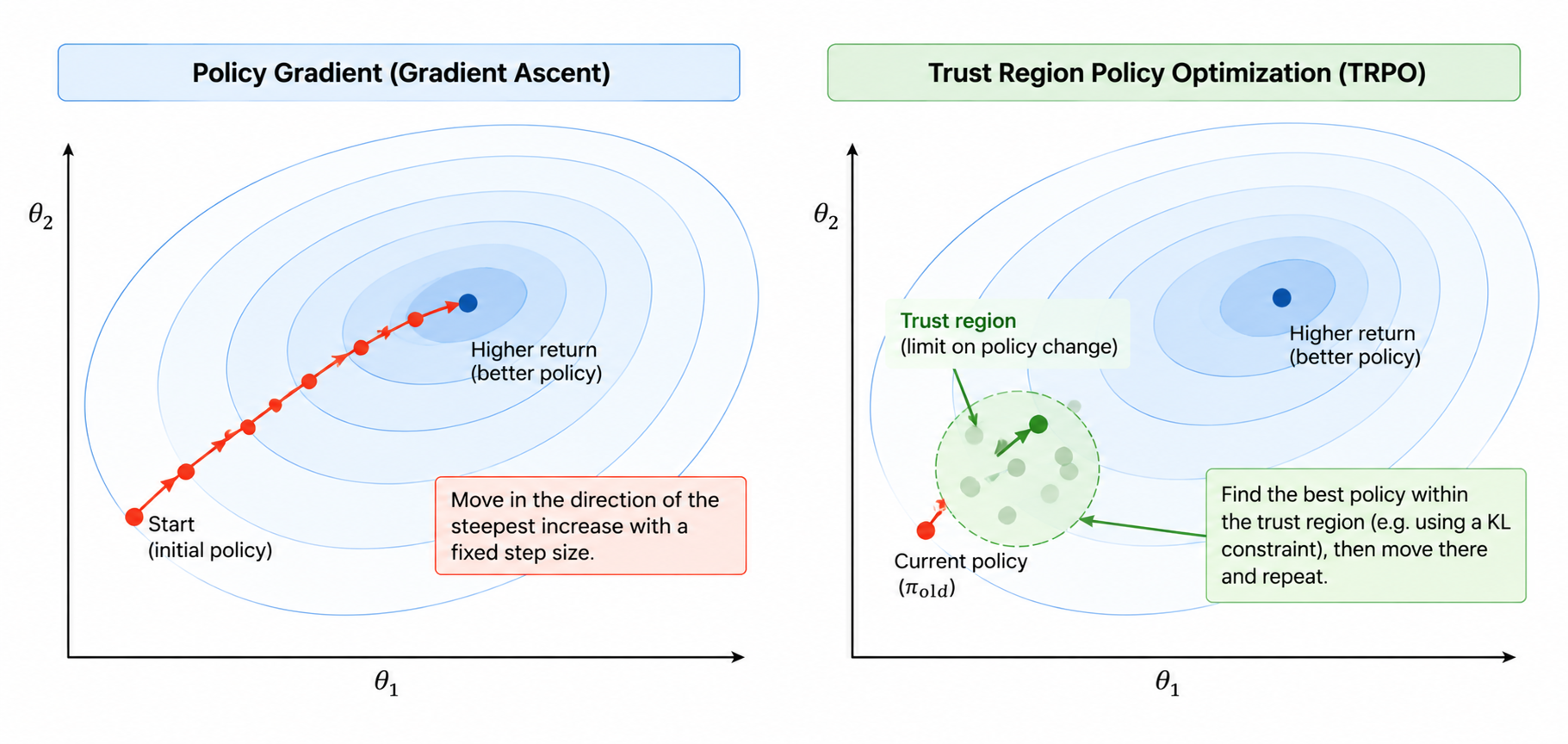
Trust-Region Based: Optimize the policy in a trust zone (closer circle).
Stochastic policies
Rock-Paper-Scissors
A deterministic policy is easily exploited
Deterministic policy: If we follow a set of action or sequence of actions, we will definitely reach the goal and will always reach teh same location.
A uniform random policy is optimal policy.
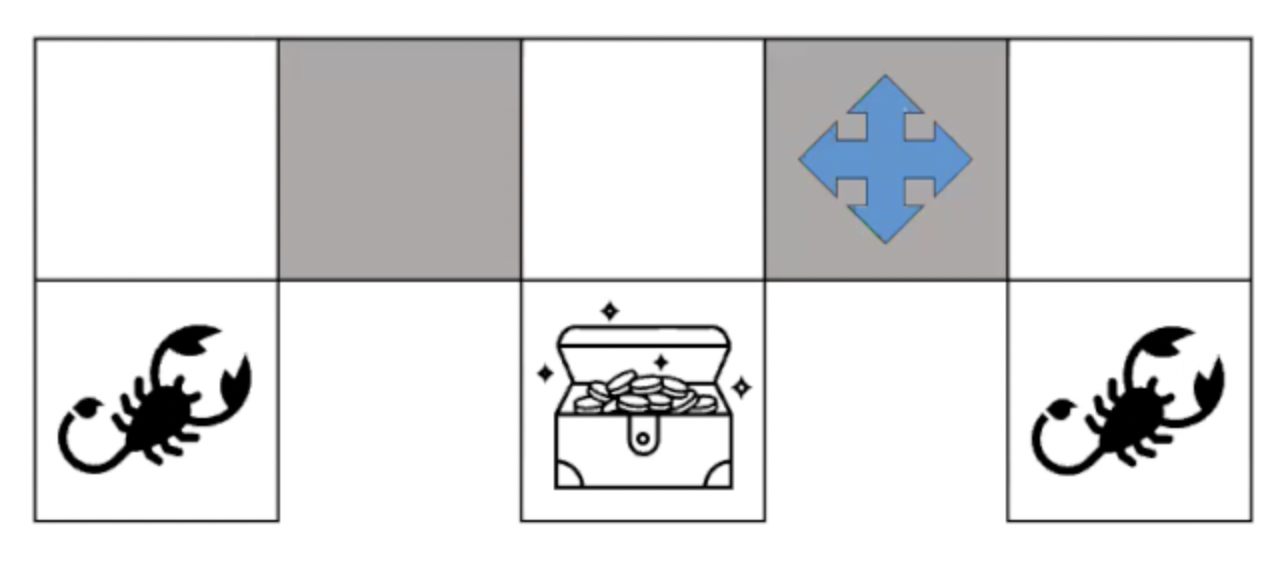
Grid World
ϕ ( s , a ) = ( 1010 ⏟ w a l l s , 0100 ⏟ a c t i o n s ) \phi(s,a) = \big(\underbrace{1 0 1 0}_{walls}, \underbrace{0 1 0 0}_{actions}\big) ϕ ( s , a ) = ( w a l l s 1010 , a c t i o n s 0100 )
Agent cannot differentiate between the grey states.
ϕ ( s , a ) \phi(s,a) ϕ ( s , a ) s s s a a a ϕ ( s , E ) = ( 1 , 0 , 1 , 0 ⏟ NESW , 0 , 1 , 0 , 0 ⏟ NESW ) \phi(s,E) = (\underbrace{1, 0, 1, 0}_{\text{NESW}}, \underbrace{0, 1, 0, 0}_{\text{NESW}}) ϕ ( s , E ) = ( NESW 1 , 0 , 1 , 0 , NESW 0 , 1 , 0 , 0 ) If π ( grey ) = W \pi(\text{grey}) = W π ( grey ) = W
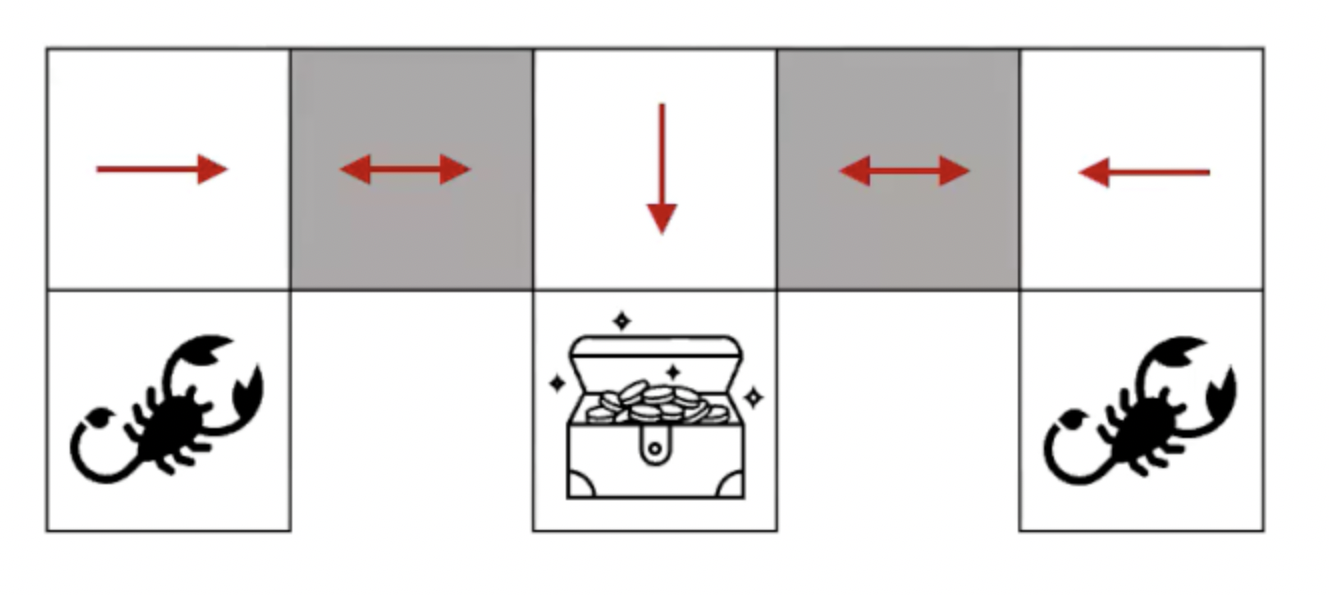
Therefore, an optimal stochastic policy moves randomly E E E W W W
π θ ( wall to N and S, move E ) = 0.5 \pi_{\theta}(\text{wall to N and S, move E}) = 0.5 π θ ( wall to N and S, move E ) = 0.5 π θ ( wall to N and S, move W ) = 0.5 \pi_{\theta}(\text{wall to N and S, move W}) = 0.5 π θ ( wall to N and S, move W ) = 0.5
The agent will reach the goal with high probability.
Policy-based methods can learn Stochastic policies.
4563
Objective Function in Policy-based Methods
Given a policy π θ ( a ∣ s ) \pi_{\theta}(a|s) π θ ( a ∣ s ) θ \theta θ θ \theta θ
J 1 ( θ ) = v π θ ( S 1 ) J_1(\theta) = v_{\pi_{\theta}}(S_1) J 1 ( θ ) = v π θ ( S 1 )
In an episodic task (with an end state), J 1 ( θ ) J_1(\theta) J 1 ( θ )
S 1 S_1 S 1 J ( θ ) J(\theta) J ( θ )
J a v V ( θ ) = ∑ s μ π θ ( s ) v π θ ( s ) J_{avV}(\theta) = \sum_{s}\mu_{\pi\theta}(s)v_{\pi\theta}(s) J a v V ( θ ) = s ∑ μ π θ ( s ) v π θ ( s )
In continuing environments (doesn't have an end state), consider the states and take the average value weighted by how often the agent visits each state.
μ π θ ( s ) \mu_{\pi\theta}(s) μ π θ ( s ) s s s
J a v R ( θ ) = ∑ s μ π θ ( s ) ∑ a π θ ( a ∣ s ) ∑ r p ( r ∣ s , a ) r J_{avR}(\theta) = \sum_{s}\mu_{\pi\theta}(s)\sum_{a}\pi_{\theta}(a|s)\sum_{r}p(r|s,a)r J a v R ( θ ) = s ∑ μ π θ ( s ) a ∑ π θ ( a ∣ s ) r ∑ p ( r ∣ s , a ) r
Use the average reward per time step.
Small batches can be used to estimate this average reward during training.
Policy-based Methods
Policy-based RL is an optimization problem, find θ \theta θ J ( θ ) J(\theta) J ( θ )
J ( θ ) J(\theta) J ( θ )
Gradient-free methods: Hill Climbing, Genetic Algorithms, ...Gradient-based
Δ θ = α ∇ θ J ( θ ) \Delta{\theta} = \alpha \nabla_{\theta} J(\theta) Δ θ = α ∇ θ J ( θ )
Policy gradient method will search for a local minimum in J ( θ ) J(\theta) J ( θ )
why ascending? because we want to maximize the objective function's value/rewards.
∇ θ J ( θ ) = ( ∂ J ( θ ) θ 1 ⋮ ∂ J ( θ ) θ n ) \nabla_{\theta} J(\theta) = \begin{pmatrix} \frac{\partial J(\theta)}{\theta_1} \\ \vdots \\ \frac{\partial J(\theta)}{\theta_n} \end{pmatrix} ∇ θ J ( θ ) = θ 1 ∂ J ( θ ) ⋮ θ n ∂ J ( θ ) α \alpha α
Δ θ J ( θ ) = ∇ θ E d [ v π θ ( s ) ] \Delta{\theta} J(\theta) = \nabla_{\theta} \mathbb{E}_d[v_{\pi\theta}(s)] Δ θ J ( θ ) = ∇ θ E d [ v π θ ( s )]
Assume the policy π θ \pi_{\theta} π θ
Compute an estimate of the policy gradient.
Compute Δ θ J ( θ ) \Delta{\theta} J(\theta) Δ θ J ( θ )
Score Function
Assume the policy π θ \pi_{\theta} π θ
∇ θ π θ ( s , a ) \nabla_{\theta} \pi_{\theta}(s, a) ∇ θ π θ ( s , a )
∇ θ π θ ( s , a ) = π θ ( s , a ) ∇ θ π θ ( s , a ) π θ ( s , a ) = π θ ( s , a ) ∇ θ log π θ ( s , a ) ( ∵ ∇ θ log f ( θ ) = 1 f ( θ ) ∇ θ f ( θ ) ) \begin{aligned}
\nabla_\theta \pi_\theta(s,a)
&=
\pi_\theta(s,a)
\frac{\nabla_\theta \pi_\theta(s,a)}
{\pi_\theta(s,a)}
\\
&=
\pi_\theta(s,a)
\nabla_\theta \log \pi_\theta(s,a)
\quad
\big(
\because \
\nabla_\theta \log f(\theta)
=
\frac{1}{f(\theta)}
\nabla_\theta f(\theta)
\big)
\end{aligned} ∇ θ π θ ( s , a ) = π θ ( s , a ) π θ ( s , a ) ∇ θ π θ ( s , a ) = π θ ( s , a ) ∇ θ log π θ ( s , a ) ( ∵ ∇ θ log f ( θ ) = f ( θ ) 1 ∇ θ f ( θ ) )
Multiplying and dividing by π θ ( s , a ) \pi_\theta(s,a) π θ ( s , a ) Likelihood Ratio Trick .
Since π θ ( s , a ) π θ ( s , a ) = 1 \frac{\pi_\theta(s,a)}{\pi_\theta(s,a)} = 1 π θ ( s , a ) π θ ( s , a ) = 1
∇ θ π θ ( s , a ) \nabla_\theta \pi_\theta(s,a) ∇ θ π θ ( s , a ) π θ ( s , a ) \pi_\theta(s,a) π θ ( s , a ) ∇ θ π θ ( s , a ) π θ ( s , a ) \frac{\nabla_\theta \pi_\theta(s,a)}{\pi_\theta(s,a)} π θ ( s , a ) ∇ θ π θ ( s , a ) θ \theta θ
From the derivative rule of the logarithm, ∇ θ π θ ( s , a ) π θ ( s , a ) = ∇ θ log π θ ( s , a ) \frac{\nabla_\theta \pi_\theta(s,a)}{\pi_\theta(s,a)} = \nabla_\theta \log \pi_\theta(s,a) π θ ( s , a ) ∇ θ π θ ( s , a ) = ∇ θ log π θ ( s , a )
Score Function : ∇ θ log π θ ( s , a ) \nabla_\theta \log \pi_\theta(s,a) ∇ θ log π θ ( s , a )
Policy Gradient Theorem
Policy Gradient = How policy changes × \times ×
It generalizes the likelihood ratio approach to multi-step MDPs.
Replaces the instantaneous reward r ( s , a ) r(s,a) r ( s , a ) Q π θ ( s , a ) Q^{\pi\theta}(s,a) Q π θ ( s , a )
s 1 → a 1 s 2 → a 2 s 3 → a 3 Goal s_1 \xrightarrow{a_1} s_2 \xrightarrow{a_2} s_3 \xrightarrow{a_3} \text{Goal} s 1 a 1 s 2 a 2 s 3 a 3 Goal
∇ θ J ( θ ) = E π θ [ ∇ θ log π θ ( s , a ) ⏟ Score Function Q π θ ( s , a ) ⏟ Action Value Function ] \
\nabla_\theta J(\theta) = \mathbb{E}_{\pi\theta}[ \underbrace{\nabla_\theta \log \pi_\theta(s,a)}_{\text{Score Function}} \underbrace{Q^{\pi\theta}(s,a)}_{\text{Action Value Function}} ] ∇ θ J ( θ ) = E π θ [ Score Function ∇ θ log π θ ( s , a ) Action Value Function Q π θ ( s , a ) ]
The theorem applies to start state objective, average reward, and average value objectives.
Q π θ ( s , a ) Q^{\pi_\theta}(s,a) Q π θ ( s , a ) s s s a a a π θ \pi_\theta π θ ∇ θ log π θ ( s , a ) \nabla_\theta \log \pi_\theta(s,a) ∇ θ log π θ ( s , a ) θ \theta θ E π θ [ ⋅ ] \mathbb{E}{\pi\theta}[\cdot] E π θ [ ⋅ ] π θ \pi_\theta π θ ∇ θ J ( θ ) \nabla_\theta J(\theta) ∇ θ J ( θ ) θ \theta θ J ( θ ) J(\theta) J ( θ )
Simplified Policy Gradient steps
Loop
Collect trajectories for Policy π θ \pi_\theta π θ
Estimate advantage function A A A
Compute Policy Gradient g ^ \hat{g} g ^
Update Policy Parameter θ new = θ old + α g ^ \theta_{\text{new}} = \theta_{\text{old}} + \alpha \hat{g} θ new = θ old + α g ^
g ^ \hat{g} g ^
Can be MC policy gradient, or Actor-Critic Policy Gradient.
if α \alpha α
if α \alpha α
REINFORCE Algorithm
Monte Carlo Policy Gradient: explore and learn from the environment and learn the optimal policy.
Update Parameters by Stochastic Gradient Ascent .
Using policy gradient theorem: find the partial derivatives to find the direction of the gradient.
Using return v t v_t v t Q π θ ( s , a ) Q^{\pi\theta}(s,a) Q π θ ( s , a )
Q π θ ( s t , a t ) = E π θ [ v t ∣ s t , a t ] Q^{\pi\theta}(s_t,a_t) = \mathbb{E}_{\pi\theta}[v_t | s_t, a_t] Q π θ ( s t , a t ) = E π θ [ v t ∣ s t , a t ]
Δ θ = α ∇ θ log π θ ( s t , a t ) v t \Delta{\theta} = \alpha \nabla_\theta \log \pi_\theta(s_t,a_t) v_t Δ θ = α ∇ θ log π θ ( s t , a t ) v t
Function REINFORCE Initialize θ arbitrarily for each episode { s 1 , a 1 , r 1 , … , s T − 1 , a T − 1 , r T } ∼ π θ do for t = 1 to T − 1 do θ ← θ + α ∇ θ log π θ ( s t , a t ) v t return θ \begin{array}{l}
\textbf{Function REINFORCE}
\\
\qquad \text{Initialize } \theta \text{ arbitrarily}
\\
\qquad \textbf{for each episode }
\{s_1,a_1,r_1,\ldots,s_{T-1},a_{T-1},r_T\}
\sim \pi_\theta
\textbf{ do}
\\
\qquad\qquad \textbf{for } t=1 \textbf{ to } T-1 \textbf{ do}
\\
\qquad\qquad\qquad
\theta
\leftarrow
\theta
+
\alpha
\nabla_\theta
\log \pi_\theta(s_t,a_t)
v_t
\\
\qquad \textbf{return } \theta
\\
\end{array} Function REINFORCE Initialize θ arbitrarily for each episode { s 1 , a 1 , r 1 , … , s T − 1 , a T − 1 , r T } ∼ π θ do for t = 1 to T − 1 do θ ← θ + α ∇ θ log π θ ( s t , a t ) v t return θ REINFORCE: Sutton and Barto
Input: a differentiable policy parameterization π ( a ∣ s , θ ) Algorithm parameter: step size α > 0 Initialize policy parameter θ ∈ R d ′ (e.g., to 0) Loop forever (for each episode): Generate an episode S 0 , A 0 , R 1 , … , S T − 1 , A T − 1 , R T , following π ( ⋅ ∣ ⋅ , θ ) Loop for each step of the episode t = 0 , 1 , … , T − 1 : G ← ∑ k = t + 1 T γ k − t − 1 R k ( G t ) θ ← θ + α γ t G ∇ ln π ( A t ∣ S t , θ ) \begin{array}{l}
\textbf{Input: } \text{a differentiable policy parameterization } \pi(a \mid s,\theta)
\\
\textbf{Algorithm parameter: } \text{step size } \alpha > 0
\\
\textbf{Initialize } \text{policy parameter } \theta \in \mathbb{R}^{d'} \text{ (e.g., to 0)}
\\
\\
\textbf{Loop forever (for each episode):}
\\
\qquad \text{Generate an episode }
S_0,A_0,R_1,\ldots,S_{T-1},A_{T-1},R_T,
\text{ following } \pi(\cdot \mid \cdot,\theta)
\\
\qquad \textbf{Loop for each step of the episode } t=0,1,\ldots,T-1:
\\
\qquad\qquad
G
\leftarrow
\sum_{k=t+1}^{T}
\gamma^{k-t-1}R_k
\qquad (G_t)
\\
\qquad\qquad
\theta
\leftarrow
\theta
+
\alpha
\gamma^t
G
\nabla
\ln \pi(A_t \mid S_t,\theta)
\end{array} Input: a differentiable policy parameterization π ( a ∣ s , θ ) Algorithm parameter: step size α > 0 Initialize policy parameter θ ∈ R d ′ (e.g., to 0) Loop forever (for each episode): Generate an episode S 0 , A 0 , R 1 , … , S T − 1 , A T − 1 , R T , following π ( ⋅ ∣ ⋅ , θ ) Loop for each step of the episode t = 0 , 1 , … , T − 1 : G ← ∑ k = t + 1 T γ k − t − 1 R k ( G t ) θ ← θ + α γ t G ∇ ln π ( A t ∣ S t , θ )
Slow to converge.
Going to have low bias but high variance.
Actor-Critic
Actor has a supervisor (Critic) that tells it how good or bad the action actor took is.
Actor : Controls agent's behavior using Policy-based methods.Critic : Measures how good the action taken by the agent is using Value-based methods.
Reducing Variance using a Critic
Q w ( s , a ) ≈ Q π θ ( s , a ) Q_w(s,a) \approx Q^{\pi\theta}(s,a) Q w ( s , a ) ≈ Q π θ ( s , a )
Monte Carlo policy gradient has high variance.
Use a Critic to estimate the action-value function.
Actor-Critic algorithms maintains two sets of parameters:
Critic : Updates action-value function parameters w w w
It is solving the problem of policy evaluation.
How good is the policy π θ \pi_\theta π θ θ \theta θ
MC or TD methods to estimate the value function.
Actor : Updates policy parameters θ \theta θ
Δ θ J ( θ ) = E π θ [ ∇ θ log π θ ( s , a ) Q w ( s , a ) ] Δ θ = α ∇ θ log π θ ( s , a ) Q w ( s , a ) \Delta_{\theta} J(\theta) = \mathbb{E}_{\pi\theta}[ \nabla_\theta \log \pi_\theta(s,a) Q_w(s,a) ] \\
\Delta_{\theta} = \alpha \nabla_\theta \log \pi_\theta(s,a) Q_w(s,a) Δ θ J ( θ ) = E π θ [ ∇ θ log π θ ( s , a ) Q w ( s , a )] Δ θ = α ∇ θ log π θ ( s , a ) Q w ( s , a )
It follows an approximate policy gradient.
Action-Value Actor-Critic
Using Linear value function approximation: Q w ( s , a ) = ϕ ( s , a ) T w Q_w(s,a) = \phi(s,a)^T w Q w ( s , a ) = ϕ ( s , a ) T w
Critic : Use Linear TD(0) to update w w w Actor : Use policy gradient to update θ \theta θ
Function Actor-Critic Initialize θ , s Sample a ∼ π θ for each step do Sample reward r = R s a Sample transition s ′ ∼ P s a Sample action a ′ ∼ π θ ( s ′ , a ′ ) δ = r + γ Q w ( s ′ , a ′ ) − Q w ( s , a ) θ = θ + α ∇ θ log π θ ( s , a ) Q w ( s , a ) w ← w + β δ ϕ ( s , a ) a ← a ′ , s ← s ′ \begin{array}{l}
\textbf{Function Actor-Critic}
\\
\qquad \text{Initialize } \theta, s
\\
\qquad \text{Sample } a \sim \pi_\theta
\\
\\
\qquad \textbf{for each step do}
\\
\qquad\qquad \text{Sample reward } r = R_s^a
\\
\qquad\qquad\text{Sample transition } s' \sim P_s^a
\\
\qquad\qquad \text{Sample action } a' \sim \pi_\theta(s',a')
\\
\\
\qquad\qquad \delta = r + \gamma Q_w(s',a') - Q_w(s,a)
\\
\qquad\qquad \theta = \theta + \alpha \nabla_\theta \log \pi_\theta(s,a) Q_w(s,a)
\\
\\
\qquad\qquad \mathbf{w} \leftarrow \mathbf{w} + \beta \delta \phi(s,a)
\\
\qquad\qquad a \leftarrow a',\; s \leftarrow s'
\end{array} Function Actor-Critic Initialize θ , s Sample a ∼ π θ for each step do Sample reward r = R s a Sample transition s ′ ∼ P s a Sample action a ′ ∼ π θ ( s ′ , a ′ ) δ = r + γ Q w ( s ′ , a ′ ) − Q w ( s , a ) θ = θ + α ∇ θ log π θ ( s , a ) Q w ( s , a ) w ← w + β δ ϕ ( s , a ) a ← a ′ , s ← s ′
δ \delta δ θ \theta θ Update w w w
Actor-Critic: Sutton and Barto
Input: a differentiable policy parameterization π ( a ∣ s , θ ) Input: a differentiable state-value function parameterization v ^ ( s , w ) Parameters: step sizes α θ > 0 , α w > 0 Initialize policy parameter θ ∈ R d ′ and state-value weights w ∈ R d (e.g., to 0) Loop forever (for each episode): Initialize S (first state of episode) I ← 1 Loop while S is not terminal (for each time step): A ∼ π ( ⋅ ∣ S , θ ) Take action A , observe S ′ , R δ ← R + γ v ^ ( S ′ , w ) − v ^ ( S , w ) ( if S ′ is terminal, then v ^ ( S ′ , w ) ≐ 0 ) w ← w + α w δ ∇ v ^ ( S , w ) θ ← θ + α θ I δ ∇ ln π ( A ∣ S , θ ) I ← γ I S ← S ′ \begin{array}{l}
\textbf{Input: } \text{a differentiable policy parameterization } \pi(a \mid s,\theta)
\\
\textbf{Input: } \text{a differentiable state-value function parameterization } \hat{v}(s,\mathbf{w})
\\
\textbf{Parameters: } \text{step sizes } \alpha^\theta > 0,\; \alpha^{\mathbf{w}} > 0
\\
\textbf{Initialize } \text{policy parameter } \theta \in \mathbb{R}^{d'}
\text{ and state-value weights } \mathbf{w} \in \mathbb{R}^{d}
\text{ (e.g., to 0)}
\\
\textbf{Loop forever (for each episode):}
\\
\qquad \text{Initialize } S \text{ (first state of episode)}
\\
\qquad I \leftarrow 1
\\
\qquad \textbf{Loop while } S \textbf{ is not terminal (for each time step):}
\\
\qquad\qquad A \sim \pi(\cdot \mid S,\theta)
\\
\qquad\qquad \text{Take action } A,\; \text{observe } S',R
\\
\qquad\qquad
\delta
\leftarrow
R
+
\gamma \hat{v}(S',\mathbf{w})
-
\hat{v}(S,\mathbf{w})
\qquad
\left(
\text{if } S' \text{ is terminal, then } \hat{v}(S',\mathbf{w}) \doteq 0
\right)
\\
\qquad\qquad
\mathbf{w}
\leftarrow
\mathbf{w}
+
\alpha^{\mathbf{w}}
\delta
\nabla \hat{v}(S,\mathbf{w})
\\
\qquad\qquad
\theta
\leftarrow
\theta
+
\alpha^\theta
I
\delta
\nabla
\ln \pi(A \mid S,\theta)
\\
\qquad\qquad
I
\leftarrow
\gamma I
\\
\qquad\qquad
S
\leftarrow
S'
\end{array} Input: a differentiable policy parameterization π ( a ∣ s , θ ) Input: a differentiable state-value function parameterization v ^ ( s , w ) Parameters: step sizes α θ > 0 , α w > 0 Initialize policy parameter θ ∈ R d ′ and state-value weights w ∈ R d (e.g., to 0) Loop forever (for each episode): Initialize S (first state of episode) I ← 1 Loop while S is not terminal (for each time step): A ∼ π ( ⋅ ∣ S , θ ) Take action A , observe S ′ , R δ ← R + γ v ^ ( S ′ , w ) − v ^ ( S , w ) ( if S ′ is terminal, then v ^ ( S ′ , w ) ≐ 0 ) w ← w + α w δ ∇ v ^ ( S , w ) θ ← θ + α θ I δ ∇ ln π ( A ∣ S , θ ) I ← γ I S ← S ′ TRPO, Trust Region Policy Optimization
A ( s , a ) = Q ( s , a ) − V ( s ) A(s,a) = Q(s,a) - V(s) A ( s , a ) = Q ( s , a ) − V ( s )
Advantage : the difference between the Q and the V values.
How good is an action compared to the average action for a specific state.
Q ( s , a ) Q(s,a) Q ( s , a ) a a a s s s V ( s ) V(s) V ( s ) s s s Used in many Deep RL algorithms such as TRPO, PPO, GRP and etc.
Stationary Target: Fixed target during training.
Update the old policy to a new policy such that they are with in a "Trusted" distance apart.
Conservative policy update allows improvement instead of degradation of policy.
Improve training stability by avoiding parameter updates that changes the policy too much at one step.
By enforcing KL divergence constraint on size of the policy update at each iteration.
Kullback-Leibler Divergence
KL divergence score
K L ( P ∣ ∣ Q ) KL(P || Q) K L ( P ∣∣ Q )
It quantifies how much one probability distribution differs from another probability distribution.
∣ ∣ || ∣∣ divergence or P P P Q Q Q
D K L ( P ∣ ∣ Q ) = ∑ x ∈ X P ( x ) log P ( x ) Q ( x ) D_{KL}(P || Q) = \sum_{x \in X} P(x) \log \frac{P(x)}{Q(x)} D K L ( P ∣∣ Q ) = ∑ x ∈ X P ( x ) log Q ( x ) P ( x )
Given two probability distributions P P P Q Q Q X X X P P P P P P Q Q Q
Multiplying by P ( x ) P(x) P ( x ) P P P
P P P Q Q Q P P P Q Q Q
e.g. π old ( a 1 ∣ s ) = 0.8 \pi_{\text{old}}(a_1|s) = 0.8 π old ( a 1 ∣ s ) = 0.8 π old ( a 2 ∣ s ) = 0.2 \pi_{\text{old}}(a_2|s) = 0.2 π old ( a 2 ∣ s ) = 0.2 π new ( a 1 ∣ s ) = 0.1 \pi_{\text{new}}(a_1|s) = 0.1 π new ( a 1 ∣ s ) = 0.1 π new ( a 2 ∣ s ) = 0.9 \pi_{\text{new}}(a_2|s) = 0.9 π new ( a 2 ∣ s ) = 0.9
The policy changed drastically in one update step.
TRPO prevents this by enforcing D K L ( π old ∥ π new ) ≤ δ D_{KL}(\pi_{\text{old}} \| \pi_{\text{new}}) \leq \delta D K L ( π old ∥ π new ) ≤ δ
TRPO vs Gradient Descent
Comparison Gradient Descent Trust Region Optimization approach Picks the steepest direction. Defines a region in which to search for the next point. Step Moves forward by a step size. Determines the maximum step size to explore. Next point Moves directly in the selected direction. Locates the optimal point within the trust region. Search process Repeats the directional step. Resumes the search from the selected point. Main characteristic Fast and simple for optimizing an objective function. Controls how far the optimization explores at each step. In Reinforcement Learning May not work well in reinforcement learning. Provides a restricted region for finding the next optimal point.
PPO, Proximal Policy Optimization
TRPO is relatively complicated, every time we need to find trust region and solve the optimization problem, leading to high computational cost.
PPO simplifies it by using a Clipped Surrogate function Based on a ratio of two policies
Current Policy π θ \pi_{\theta} π θ
Baseline Policy (Old Policy) π θ old \pi_{\theta_{\text{old}}} π θ old
Policy Ratio
r t ( θ ) = π θ ( a t ∣ s t ) π θ old ( a t ∣ s t ) r_t(\theta)
=
\frac{\pi_\theta(a_t|s_t)}
{\pi_{\theta_{\text{old}}}(a_t|s_t)} r t ( θ ) = π θ old ( a t ∣ s t ) π θ ( a t ∣ s t )
r t ( θ ) = 1 r_t(\theta)=1 r t ( θ ) = 1 r t ( θ ) > 1 r_t(\theta)>1 r t ( θ ) > 1 r t ( θ ) < 1 r_t(\theta)<1 r t ( θ ) < 1
The surrogate objective is:
J ( θ ) = E t [ r t ( θ ) A ^ t ] J(\theta)
=
\mathbb{E}_t
\left[
r_t(\theta)\hat A_t
\right] J ( θ ) = E t [ r t ( θ ) A ^ t ]
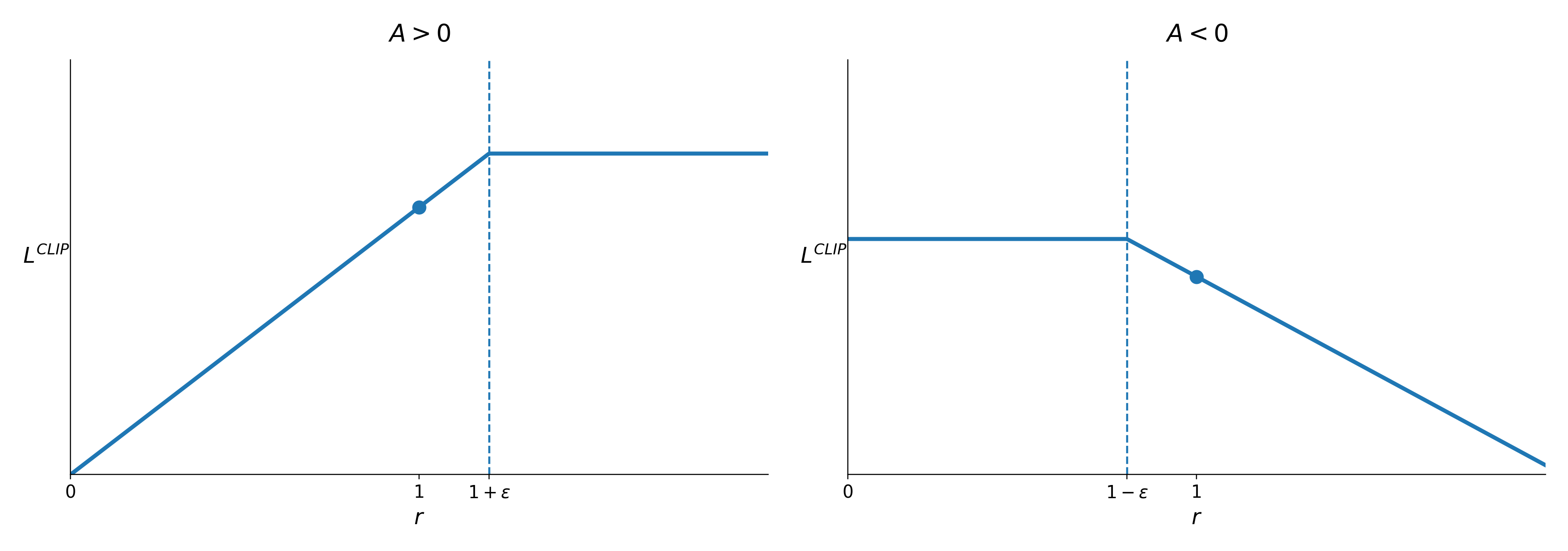
A ^ t > 0 \hat A_t>0 A ^ t > 0 A ^ t < 0 \hat A_t<0 A ^ t < 0 Without a restriction, the policy may change too much in a single update.
Clipped Surrogate Objective
J C L I P ( θ ) = E ^ t [ min ( r t ( θ ) A ^ t ⏟ Normal Policy Gradient objective , clip ( r t ( θ ) , 1 − ϵ , 1 + ϵ ) ⏟ Clipped Policy Gradient Objective A ^ t ) ] J^{CLIP}(\theta)
=
\hat{\mathbb E}_t
\left[
\min
(
\underbrace{r_t(\theta)\hat A_t}_{\text{Normal Policy Gradient objective}},
\underbrace{\operatorname{clip}
(r_t(\theta),1-\epsilon,1+\epsilon)}_{\text{Clipped Policy Gradient Objective}}\hat A_t
)
\right] J C L I P ( θ ) = E ^ t min ( Normal Policy Gradient objective r t ( θ ) A ^ t , Clipped Policy Gradient Objective clip ( r t ( θ ) , 1 − ϵ , 1 + ϵ ) A ^ t )
r t ( θ ) = π θ ( a t ∣ s t ) π θ old ( a t ∣ s t ) r_t(\theta) = \frac{\pi_\theta(a_t|s_t)}{\pi_{\theta_{\text{old}}}(a_t|s_t)} r t ( θ ) = π θ old ( a t ∣ s t ) π θ ( a t ∣ s t ) A ^ t = Q ( s t , a t ) − V ( s t ) \hat A_t = Q(s_t,a_t) - V(s_t) A ^ t = Q ( s t , a t ) − V ( s t ) ϵ \epsilon ϵ 0.1 0.1 0.1 0.2 0.2 0.2 If ϵ = 0.2 \epsilon=0.2 ϵ = 0.2 [ 0.8 , 1.2 ] [0.8,1.2] [ 0.8 , 1.2 ]
For A ^ t > 0 \hat A_t>0 A ^ t > 0 r t r_t r t 1 + ϵ 1+\epsilon 1 + ϵ
For A ^ t < 0 \hat A_t<0 A ^ t < 0 r t r_t r t 1 − ϵ 1-\epsilon 1 − ϵ
The policy ratio itself is not strictly forced to remain inside the clipping range.
Instead, clipping removes the incentive for excessively large beneficial policy updates.
Algorithm: PPO with Clipped Objective Input: θ 0 , ϵ for k = 0 , 1 , 2 , … do Collect set of partial trajectories D k on policy π k = π ( θ k ) Estimate advantages A ^ t π k using any advantage estimation algorithm Compute policy update θ k + 1 = arg max θ L θ k C L I P ( θ ) by taking K steps of minibatch SGD (via Adam), where L θ k C L I P ( θ ) = E τ ∼ π k [ ∑ t = 0 T min ( r t ( θ ) A ^ t π k , clip ( r t ( θ ) , 1 − ϵ , 1 + ϵ ) A ^ t π k ) ] \begin{array}{l}
\textbf{Algorithm: PPO with Clipped Objective} \\
\textbf{Input: } \theta_0,\ \epsilon \\
\textbf{for } k=0,1,2,\ldots \textbf{ do} \\
\qquad \text{Collect set of partial trajectories } \mathcal{D}_k
\text{ on policy } \pi_k=\pi(\theta_k) \\
\qquad \text{Estimate advantages } \hat{A}_t^{\pi_k}
\text{ using any advantage estimation algorithm} \\
\\
\qquad \text{Compute policy update} \\
\qquad \theta_{k+1}
=
\arg\max_{\theta}
\mathcal{L}_{\theta_k}^{CLIP}(\theta) \\
\\
\qquad \text{by taking } K \text{ steps of minibatch SGD (via Adam), where} \\
\qquad
\mathcal{L}_{\theta_k}^{CLIP}(\theta)
=
\mathbb{E}_{\tau\sim\pi_k}
\left[
\sum_{t=0}^{T}
\min
\left(
r_t(\theta)\hat{A}_t^{\pi_k},
\operatorname{clip}
\left(
r_t(\theta),1-\epsilon,1+\epsilon
\right)
\hat{A}_t^{\pi_k}
\right)
\right] \\
\end{array} Algorithm: PPO with Clipped Objective Input: θ 0 , ϵ for k = 0 , 1 , 2 , … do Collect set of partial trajectories D k on policy π k = π ( θ k ) Estimate advantages A ^ t π k using any advantage estimation algorithm Compute policy update θ k + 1 = arg max θ L θ k C L I P ( θ ) by taking K steps of minibatch SGD (via Adam), where L θ k C L I P ( θ ) = E τ ∼ π k [ ∑ t = 0 T min ( r t ( θ ) A ^ t π k , clip ( r t ( θ ) , 1 − ϵ , 1 + ϵ ) A ^ t π k ) ]
θ 0 \theta_0 θ 0 ϵ \epsilon ϵ A ^ t π k \hat{A}_t^{\pi_k} A ^ t π k A π ( s , a ) = Q π ( s , a ) − V π ( s ) A_\pi(s,a)=Q_\pi(s,a)-V_\pi(s) A π ( s , a ) = Q π ( s , a ) − V π ( s ) a t ∼ π ( a t ∣ s t ) , s t + 1 ∼ P ( s t + 1 ∣ s t , a t ) a_t\sim\pi(a_t\mid s_t),\quad
s_{t+1}\sim P(s_{t+1}\mid s_t,a_t) a t ∼ π ( a t ∣ s t ) , s t + 1 ∼ P ( s t + 1 ∣ s t , a t ) t ≥ 0 t\ge0 t ≥ 0