본문으로 건너뛰기

"drone" 태그로 연결된 3개 게시물개의 게시물이 있습니다.

모든 태그 보기

Coverage analysis and Efficient placement of drone BS review

· 약 3분
Summary

  • This study reformulates Drone-BS 3D deployment as a SINR-based coverage probability optimization problem rather than a distance- or area-based one.
  • By jointly considering LOS/NLOS propagation, altitude-dependent SINR behavior, and system constraints, the deployment problem is formulated as an NP-hard MINLP.
  • A meta-heuristic optimizer (GWO) is used as a practical solver, demonstrating that high coverage can be achieved with a minimal number of Drone-BSs.

Introduction

Background

  • In 5G networks, Drone-BSs (UAV-BSs) have attracted significant attention as a promising solution to enhance coverage and capacity in dense urban environments.
  • Although the use of the mmWave band enables high data rates, determining the optimal 3D deployment (horizontal location and altitude) of Drone-BSs has emerged as a critical challenge.

Limitations of Existing Studies

  • Assumption of fixed Drone-BS altitude
  • Reliance on heuristic-based approaches
  • Consideration of limited system constraints

Objective of This Study

  • This study aims to derive an optimal Drone-BS deployment strategy by combining
  • SINR-based downlink coverage probability analysis and
  • a meta-heuristic optimization algorithm, namely the Grey Wolf Optimizer (GWO).

Methods

System Model

  • Users (N) and Drone-BSs (M) are randomly distributed in an urban environment.
  • A mmWave path loss model considering LOS and NLOS propagation conditions is applied.
  • A predefined SINR threshold is used as the Quality-of-Service (QoS) criterion.

Coverage Probability Analysis

  • The probability that SINR exceeds a predefined threshold is derived based on stochastic geometry.
  • Shadow fading is modeled as a Gaussian random variable.
  • The downlink coverage probability is expressed using a Q-function formulation.

Optimization Problem Formulation

  • Objective function
    • Maximize the number of covered users.
  • Constraints
    • Minimum number of deployed Drone-BSs
    • Drone-BS altitude limits
    • Total available bandwidth constraint
  • The problem is formulated as a Mixed Integer Non-Linear Programming (MINLP) problem and is NP-hard.

Solution Approach

  • The Grey Wolf Optimizer (GWO) is employed to search for the optimal 3D locations (x, y, h) of Drone-BSs.

Results

Simulation Setup

  • Area size: 2 × 2 km²
  • Number of users: 200
  • Maximum number of Drone-BSs: 10
  • Carrier frequency: 28 GHz

Key Findings

  • The downlink coverage probability increases as the Drone-BS altitude increases.
  • A coverage probability of approximately 0.76–0.82 can be achieved with only five Drone-BSs.
  • Reducing the number of Drone-BSs leads to uncovered regions.
  • Increasing the number of Drone-BSs may result in higher inter-cell interference.

Discussion

Performance Analysis

  • The GWO-based deployment achieves high coverage performance while minimizing the number of Drone-BSs.
  • Increasing altitude improves coverage but introduces a trade-off in terms of reduced energy efficiency.

Limitations and Future Work

  • The proposed approach does not consider blockage effects or handover and coverage overlap issues.
  • These aspects are identified as important directions for future research.

Terminology

  • Drone-BS: Drone Base Station
  • GWO: Grey Wolf Optimizer, a nature-inspired optimization algorithm based on the social hierarchy and hunting behavior of grey wolves.
  • LOS: Line of Sight, a direct path between transmitter and receiver without obstructions.
  • MINLP: Mixed Integer Non-Linear Programming, an optimization problem involving both integer and continuous variables with non-linear relationships.
  • NLOS: Non-Line of Sight, a path between transmitter and receiver that is obstructed.
  • SINR: Signal to Interference plus Noise Ratio, a measure of signal quality.
  • UVA-BS: Unmanned Aerial Vehicle Base Station

Ref

  • Ouamri, M. A., Oteşteanu, M.-E., Barb, G., & Gueguen, C. (2022). Coverage Analysis and Efficient Placement of Drone-BSs in 5G Networks. The 1st International Conference on Computational Engineering and Intelligent Systems, 18. https://doi.org/10.3390/engproc2022014018
Comparative analysis of ML algorithms for 5G coverage prediction review

· 약 3분

Summary

  • Model performance in 5G coverage prediction is primarily determined by the alignment between data characteristics, feature design, and model inductive bias, rather than by model complexity alone.
  • Using real-world 5G NR drive-test data with physics-informed numerical features, this study demonstrates that Random Forest can achieve SOTA performance, outperforming more complex models such as XGBoost and deep neural networks.
  • The results highlight the continued importance of domain-informed feature engineering and show that deep learning becomes advantageous only when the data representation and scale justify its use.

Introduction

  • Coverage prediction in 5G networks is a core component of network planning, optimization, and resource allocation.
  • Conventional propagation and path loss models are limited in their ability to accurately capture the complexity of dense urban environments and the unique characteristics of 5G systems.
  • Machine Learning and Deep Learning have emerged as promising alternatives, as they can model complex non-linear relationships across multiple parameters.
  • However, prior studies typically suffer from several limitations:
    • Most focus on 4G networks or rely on a limited set of input features.
    • Comparisons across a wide range of algorithms are often insufficient.
    • Systematic analyses of feature importance are largely lacking.

The objectives of this study are to:

  • Conduct a comprehensive comparison of multiple ML and DL algorithms using a unified dataset.
  • Identify dominant feature parameters that significantly influence 5G coverage prediction.
  • Demonstrate performance improvements over previously reported methods.

Methods

Data Collection

  • Real-world 5G NR drive test measurements conducted in Bandung, Indonesia (Batununggal area).
  • Approximately 1,500 SS-RSRP samples collected.
  • Deployment includes 10 gNodeBs, each configured with three sectors.
  • Measurement vehicle speed maintained below 30 km/h to minimize fast fading effects.

Input Features (10 Total)

  • 2D Distance between Transmitter and Receiver
  • Frequency
  • Transmitter Tilt Angle
  • Transmitter Azimuth Angle
  • Altitude
  • Elevation Angle
  • Azimuth Offset Angle
  • Tilting Offset Angle
  • Horizontal Distance of Receiver from Transmitter Antenna Boresight
  • Vertical Distance of Receiver from Transmitter Antenna Boresight

Algorithms

Machine Learning (Classification-based):

  • Logistic Regression
  • K-Nearest Neighbors (KNN)
  • Naive Bayes
  • Random Forest
  • Support Vector Machine (SVM)
  • XGBoost
  • LightGBM
  • AdaBoost
  • Bayesian Network Classifier

Deep Learning:

  • Multi-Layer Perceptron (MLP)
  • Long Short-Term Memory (LSTM)
  • Convolutional Neural Network (CNN)

Training and Validation

  • Experiments conducted using Google Colab.
  • 10-fold cross-validation applied for all models.
  • Hyperparameter optimization performed only on the best-performing models.

Evaluation Metrics

  • Regression Metrics: RMSE, MAE, R²
  • Classification Metrics: Accuracy, Precision, Recall, F1-score

Results

Machine Learning

Random Forest:

  • RMSE = 1.14 dB
  • MAE = 0.12
  • R² = 0.97
  • Accuracy / Precision / Recall / F1-score ≈ 98.4%

Deep Learning

Convolutional Neural Network (CNN):

  • RMSE = 0.289

  • MAE = 0.289

  • R² = 0.78

  • Accuracy = 75%

  • Precision = 85.6%

  • Recall = 87.8%

  • F1-score = 89.9%

  • MLP and LSTM exhibit inferior performance compared to CNN.

Feature Importance

  • The 2D Transmitter–Receiver Distance is identified as the most dominant feature across all algorithms.
  • Incorporating horizontal and vertical distances from the antenna boresight significantly improves prediction accuracy.

Comparison with Previous Studies

  • Both Random Forest and CNN achieve lower RMSE values compared to prior studies.
  • Random Forest, in particular, demonstrates state-of-the-art performance relative to existing 4G and 5G coverage prediction research.

Discussion

  • Random Forest
    • Highly effective for small-to-medium-sized datasets with numerical features.
    • Offers strong interpretability and robust performance stability.
  • Convolutional Neural Network
    • Well-suited for grid-based or spatial data representations.
    • Shows greater potential when image-based or satellite-derived features are incorporated.
    • In this study, CNN was applied by transforming numerical features into a matrix-like structure.
  • The results empirically demonstrate that feature design and selection can be more critical than the choice of learning algorithm itself.

Location-Aware Deep Neural Network Review

· 약 3분

Architecture

Wall Detection

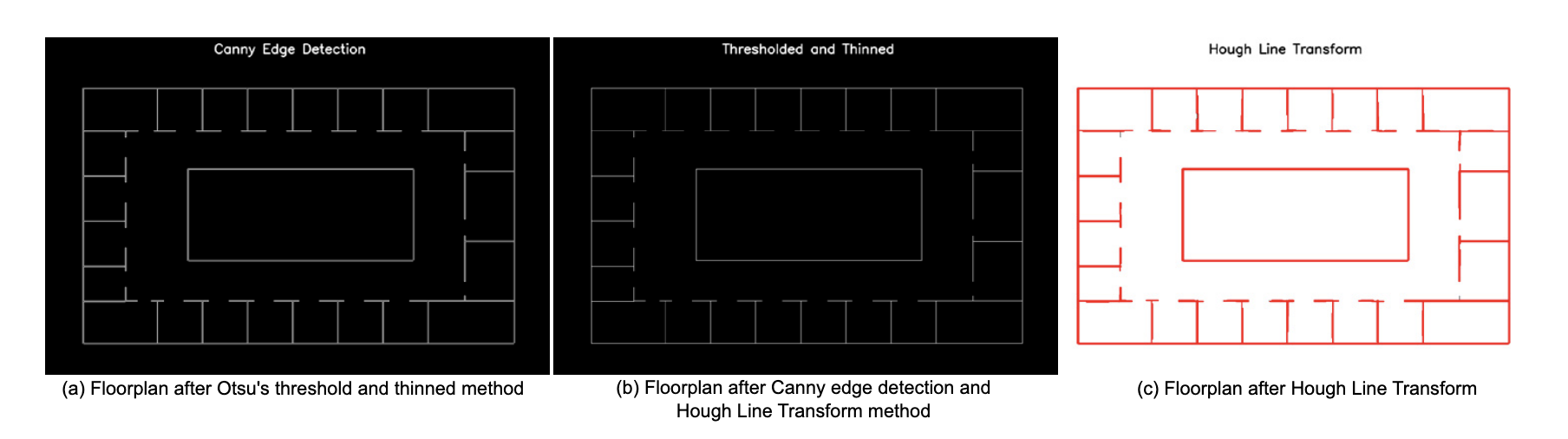
Wall Detection Process

  1. Pre-process floor images to gray scale.
  2. Apply Otsu's threshold and thinned method.
  3. Enhance the contrast of wall lines using Canny edge detection.
  4. Employ Hough Transform to detect and map wall lines.

3D Visualization

Limitations

  • Building structural details are unavailable or drone operations are restricted.
  • Highly irregular floor plans or buildings constructed with unique materials not extensively represented in the training data.
  • Real-time data integration
  • Refined deep learning architectures, and validation across varied building materials and layouts
  • Enhance the framework’s scalability and practical utility.

Spider GAN

Sample

{
"nodes": [
{ "id": 0, "name": "Drone", "type": "source", "features": [1, 0, 0, 0, 0.0] },
{ "id": 1, "name": "Room1", "type": "room", "features": [0, 1, 0, 0, -70.0] },
{ "id": 2, "name": "Room2", "type": "room", "features": [0, 1, 0, 0, -75.0] },
{ "id": 3, "name": "Room3", "type": "room", "features": [0, 1, 0, 0, -80.0] },
{ "id": 4, "name": "Corridor","type": "corridor", "features": [0, 0, 1, 0, -72.0] },
{ "id": 5, "name": "Wall_R1_R2","type": "wall", "features": [0, 0, 0, 1, 0.0] },
{ "id": 6, "name": "Wall_R2_R3","type": "wall", "features": [0, 0, 0, 1, 0.0] }
],

"edges": [
{ "source": 0, "target": 1, "attenuation_db": 5.0 },
{ "source": 1, "target": 5, "attenuation_db": 8.0 },
{ "source": 5, "target": 2, "attenuation_db": 8.0 },
{ "source": 2, "target": 6, "attenuation_db": 10.0 },
{ "source": 6, "target": 3, "attenuation_db": 10.0 },
{ "source": 2, "target": 4, "attenuation_db": 3.0 }
]
}

Ref

  • Hason Rudd, D., Sanin, C., En, K. M., Gao, X., Islam, M. R., Hasan, M., Wang, X., Huo, A., & Xu, G. (2025). Location-Aware Deep Neural Network for Predicting Indoor 5G RSSI and CQI Using Drone-Based External RF Sensing. Procedia Computer Science, 270, 4765–4775. https://doi.org/10.1016/j.procs.2025.09.602