CNN 008
· 약 4분
Datasets
PASCAL isual Object Classifcation
PASCAL VOC
- a popular dataset for object detection, classification and segmentation
- 20 categories
ImageNet
- a dataset for object detection
- 500,000 images, 200 categories
- Not very popular due to large number of classes and size of the dataset
COCO
Microsoft Common Objects in Context dataset
- a large-scale object detection, segmentation, and captioning dataset.
- 330,000 images, 80 categories
- 200,000 labeled images, 1.5 million object instances
- 91 stuff categories
Intersecxtion over Union (IoU)
- a metric used of the evaluation of an object detector
- how good is the predicted bounding box for an object detected colosely matches
AP
Average Precision
| Metric | Description |
|---|---|
| AP at IoU=.50:0.05:0.95 (primary challenge metric) | |
| AP at IoU=0.50 (PASCAL VOC metric) | |
| AP at IoU=0.75 (strict metric) | |
| AP for small objects: | |
| AP for medium objects: | |
| AP for large objects: | |
| AR given 1 detection per image | |
| AR given 10 detections per image | |
| AR given 100 detections per image | |
| AR for small objects: | |
| AR for medium objects: | |
| AR for large objects: |
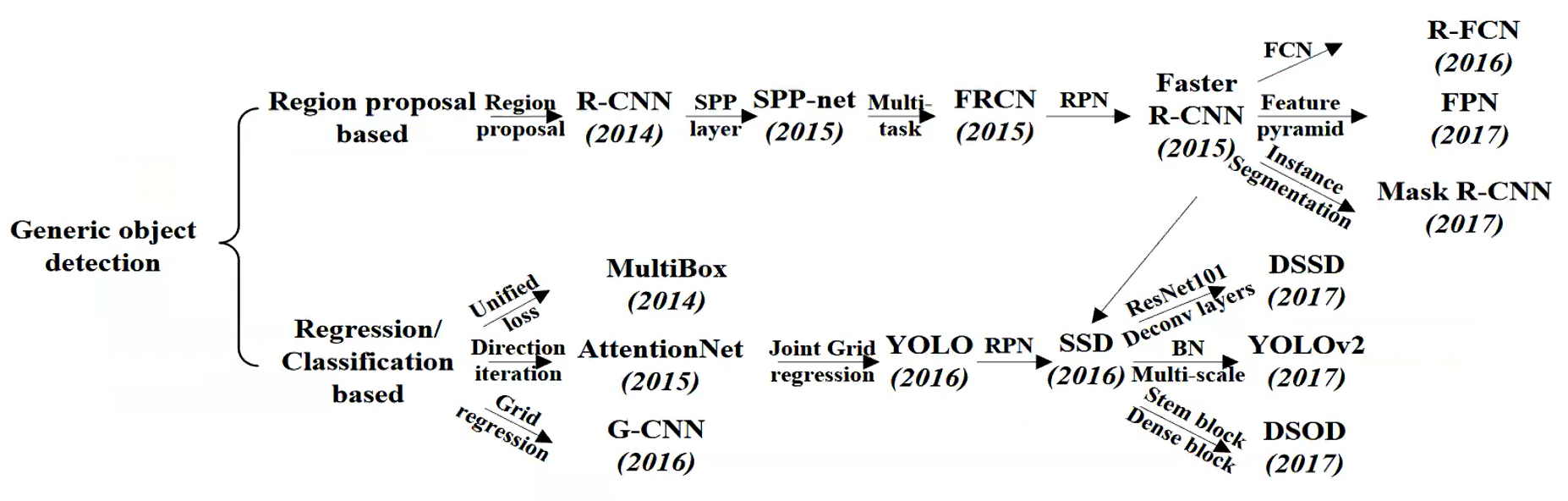
Taxonomy of Object Detection
History of Object Detection
Classification with Localization
- Classification Task
- Input: Image
- Output: Class label
- Performance Metric: Accuracy
- Localization Task
- Input: Image
- Output: Bounding box coordinates or
- Performance Metric: IoU
Localization Loss
Localization as a regression problem
Detection as a Classification Problem
Region Proposal
- Find blobs in the image that are most likely to contain objects.
- Selective Search: ~1000-2000 region proposal using CPU
R-CNN
Region based CNN
- Convolution Neural Network as feature extractor
- SVM as classifier
- Bounding box regression for localization
- Pass each region through CNN to extract features, then classify using SVM and refine bounding box using regression
- Warped image region to fixed size (e.g., 227x227) before passing through CNN
- Region-of-Interest (RoI) from proposal method around 2000 per image, which is computationally expensive
Fast R-CNN
- Run Whole image through CNN to get feature map, then classify each region proposal using RoI pooling and fully connected layers
- Region of Interest (RoIs) from proposal method
- Crop and Resize features
- Per-Region Network
- Linear + Softmax for Object category
- Linear for Box offset
- Reduce computation
- ROIs from feature maps using selective search
- mAP: 70% for PASCAL VOC 2007
Faster R-CNN
- Use CNNs to make proposal
- RPN (Region Proposal Network) to generate region proposals
- Small nural network to predict proposals from feature map
- RoI pooling to extract features for each proposal
- then classify and refine bounding box
- mAP: 78.8% for PASCAL VOC 2007
| Model | Description |
|---|---|
| R-CNN | Look at every patch one by one |
| Fast R-CNN | Look once, and then inspect patches on feature map |
| Faster R-CNN | Propose patches using a neural network (RPN) |
R-CNN Family Comparison
| Feature | R-CNN | Fast R-CNN | Faster R-CNN |
|---|---|---|---|
| Region proposal | Selective search | Selective search | RPN (learned) |
| CNN Usage | Per region | Once per image | Once per image |
| Speed | Very slow | Faster | Can work in real-time |
| Training | Multi-stage, discrete | Partially end-to-end | Fully end-to-end |
| Accuracy | Good | Better | Best of all three |
Image Annotation for Object Detection
- difficulty: not easy to annotate images even for humans