본문으로 건너뛰기

Full Stack JavaScript Developer | Half-time Open Sourcerer.

모든 저자 보기

FSD +001

· 약 8분

Software Engineering

SDLC

SW Development Methodologies

Waterfall

  • Pros
    • Simple & easy: each phase has specific deliverables
    • Clear & set milestones
    • Fixed requirements
    • Works well for small projects with specific set of requirements
    • Determine the schedule early
    • Clear structure
  • Cons
    • Working sw produced only at the end
    • High uncertainty of sw quality and functionality
    • Delayed testing, delays sw bugs discovery
    • After completion, no formal way to change the requirements
    • Fix working model, difficult to implement for complex projects

Agile

  • Iterative cyclical progression of the SDLC
    • Repetitive structure based on iterations (sprints)
    • 2 ~ 4 weeks, SDLC repeats
    • Each release has 3 or more iterations
    • Working prototype is produced at the end of each iteration
    • Prototype is for QA and used as input for next iteration
    • Multiple releases
  • Pros
    • Innovation through team collaboration
    • Time to market
    • Continuous testing
    • Risk reduction, finding sw bugs early
    • Customer feedback loop
    • Flexibility to change requirements
    • Automates most of the SDLC === DevOps approach
  • Cons
    • Lack of long-term planning
    • Cost estimation is difficult
    • Limited documentation
    • No finite end
    • Difficult to see the end result due due to cyclic nature of agile

SW Development Paradigms

Procedural Programming

  • Top-down decomposition: Each sub-problem is typically implemented as a function or procedure
  • Root represents the main program
  • Leaves denote individual procedures or functions

Object-Oriented Programming

  • Abstraction: The process of hiding unnecessary details
  • Encapsulation: Restricts the direct access to components of an object, while using methods to access and modify the data
  • Inheritance: The process of creating sub-class
  • Polymorphism: Allows for the creation, use, and storage of multiple objects that inherit from the same parent class

Requirements Analysis

Instructions provided by the stakeholder describe a target system

  • system properties, attributes and how a system should behave
  • Decomposed into Functional requirements / Non-functional requirements

Requirements Validation

  • Compliance
  • Correctness
  • Completeness
  • Consistency
  • Usability
CriteriaDescriptionSatisfactory Score (0-5)Recommendations
ComplianceDegree to which the requirements meet with industry standards and regulations0-
CorrectnessDegree to which the requirements is correct in terms of spelling, accuracy, grammatically.0-
CompletenessDegree to which the functional requirements match the intended software behavior0-
ConsistencyDegree to which the requirements can be mapped to use cases0-
ExpandabilityDegree to which the requirements can be modified and improved to meet the project objectives0-

Use Case

an actor wants the system to, and captures functional requirements

  • always started by an actor, always written from the perspective of the actor
  • a series of actions that a user must initiate to carry out some useful work and to achieve a goal
    • preconditions -> main flow -> alternative flow -> postconditions
  • reflects all the possible events in the system
  • complete set of use cases describes all the possible ways the system will behave and defines all the requirements

Use Case Backlog Template

IDUse Case TitleActor(s)Goal/DescriptionPreconditionsPostconditionsPriorityStatusNotes
UC-001User LoginUserAllow users to log in to the systemUser must have an accountUser is logged inHighOpen-
UC-002View ProfileUserAllow users to view their profile informationUser must be logged inUser profile is displayedMediumOpen-

User Stories

  • Planned to be delivered in a single iteration, some user stories may span multiple iterations
  • Single requirement expressed from developer's perspective
  • Describes a functional or non-functional requirement
  • As a student
  • I want to submit assignments online
  • so that I can receive feedback from my instructor.
IDUser StoryAcceptance CriteriaPriorityStatusStory PointsNotes
US-001As a student, I want to submit assignments online so that I can receive feedback from my instructor.- User can upload assignment files
- User receives confirmation of submission
- Instructor can view submitted assignments
HighOpen5-
US-002As a student, I want to view my grades online so that I can track my academic progress.- User can view grades for each assignment
- User can see overall course grade
- Grades are updated in real-time
MediumOpen3-

UML

  • Actors: Entity that performs actions in the system
  • Use Cases: Oval representation inside the system boundary of a functional requirement
  • System Boundary: Square representation of the system scope
  • Relationships
    • Association: Between an actor and a use case
    • Include: Between use cases, The included use case is always necessary for the completion of the activating use case.
    • Extend: Between use cases, The extension use case is activated occasionally at specific extension point.
    • Generalization/Inheritance: Between use cases, they achieve the same goal but in different ways.

Use Case Model

  • System boundary: Defines the scope of the system
  • Generalization: Describes the shared parts in a parent use case, then specializes in child use cases
    • Inherit features from their parent use case
    • Add new features
    • Change inherited features
  • Short, simple use cases on the core functionality may be completed within one iteration.
  • Keep use cases short and simple
  • Focus on what, not the how
  • Avoid functional decomposition

UML Use Case Model

  • CRUD
    • Create a record
    • Retrieve the record given a key
    • Update the record with new data and store it
    • Delete a record
  • Each is a separate goal, possibly carried by a different person with a different security level.

AI 에이전트와 환경

· 약 4분

에이전트와 환경의 상호작용

환경

  • Static environment: crossword puzzle
  • Semi-dynamic environment: Chess
  • Dynamic environment: self-driving car

연구문제(Research Problem)의 개념, 유형, 선택 전략

· 약 3분

1. 연구문제 정의 및 역할

연구문제는 사회·행동과학에서 분석의 출발점이자 글쓰기의 핵심 조직 원리이며 학문적 소통의 중심 주제이며, 다른 연구 주제로의 확장 기반이 된다.

  • 새로운 지식과 이해 도출
  • 실용적 해결책 또는 정책 제안
  • 인간 조건 개선
  • 실천적 방법론 개발

2. 연구문제 유형과 예시 (기후변화 주제 기반)

유형설명기후 변화 예시
Action사회 변화 유도 목적가뭄 지역 식량 운송 개선
Applied실용적 해결 목표해수면 상승 → 기반시설 개선
Causal인과관계 분석빙하 감소 → 농업 ↓ → 경제 ↓
Developmental개념 확산/수용 과정 분석재생에너지 수용 인식 변화
Exploratory미지 영역 탐색산불 연기 → 노인 건강 영향 조사
Predictive미래 예측북극 해빙 → 항로 개방 대응 시나리오
Theoretical개념적 이론 확장장소애착 이론을 통한 메시지 전략

3. 연구문제 선정 절차

A. 주제를 제공받는 경우

  1. 핵심 개념 및 용어 도출
  2. 배경문헌 검토 (ProQuest, JSTOR 등)
  3. 비판적 시각 형성 (찬반 근거 확보)
  4. 아웃라인 구성

B. 주제 리스트에서 선택하는 경우

  • “쉬운 주제”보다 흥미, 전공, 개인적 의미 고려
  • 위와 같은 절차 적용

C. 자유 주제 설정

  1. “무엇을 이해하고 싶은가?”라는 질문에서 시작
  2. 아이디어 수집 전략
    • 강의자료, 시사 뉴스, SNS, 과거 과제 등
  3. 주제를 연구문제로 구체화 후 위 절차 적용

4. 문헌 활용 전략

활용 방식설명
비판적 활용기존 주장의 약점을 반박하거나 대안 제시
아이디어 확장타인의 관점으로 본인 주장을 보완
역사적 맥락 제공주제의 시간적 변화나 발전 과정을 조망
학제 간 통찰 확보사회학, 정치학 등 다양한 관점 비교 분석

5. 연구문제 vs 논제 (Thesis Statement)

구분연구문제논제 (Thesis)
목적해결해야 할 문제 제시문제에 대한 명확한 입장 표명
문서 위치서론 초반서론 마지막 문단
성격측정 가능한 현상 기술분석, 주장, 평가 등 입장 제시
관계논제의 기반이 됨연구문제 해석 결과로 도출됨

6. 실전 리서치 팁

  • Google Scholar의 "Cited by" 기능으로 후속 연구 추적
  • 동의어 및 관련 키워드로 검색 확장
  • 참고문헌 추적: 자주 인용된 자료는 핵심 이론일 가능성 높음
  • EndNote, RefWorks로 문헌 정리
  • 아웃라인 작성 시 논리적 공백이 생기면 추가 조사 필요

7. 참고용 리서치 도구 및 플랫폼

  • CQ Researcher – 이슈 중심의 정책 보고서 제공
  • Opposing Viewpoints In Context – 사회 문제에 대한 다양한 관점
  • Policy Commons – 글로벌 정책 데이터베이스
  • JSTOR – 학술지 기반의 과거 연구 자료
  • New York Times Topics – 주요 시사 이슈 정리 및 자료

8. 개선 제안 요약

항목제안 내용
유형 비교 도식화7가지 유형을 목적/적용성과 함께 도식화
검색 예시 보강고급 검색식 예시 추가 (ex. “EU AND terrorism AND credibility”)
논제 예시 확장분석형, 설명형, 주장형 등 다양한 논제 샘플 제시
실패 사례 제시과도하게 좁은 주제나 불명확한 문제 사례 소개
전체 개요 문단 추가전체 문서 요약용 300자 내외 개요 삽입 (블로그/논문 개요에 활용 가능)

Vocabulary for AI +001

· 약 6분

Vocabulary & Expressions

Term/ExpressionDefinitionSimpler ParaphraseMeaning
rationalityThe quality of being based on reason or logicLogical thinking합리성
merelyJust; Onlyonly단지
concedeTo admit something is true after denying itadmit인정하다
empiricalBased on observation or experience rather than theoryobservational경험적인
disparageTo regard or represent as being of little worthbelittle폄하하다
extrapolateTo extend the application of a method or conclusion to an unknown situation by assuming existing trends will continueinfer추론하다
devote sth to sth/soTo give one's time, effort, or resources to a particular task or purposededicate헌신하다
preciseMarked by exactness and accuracy of expression or detailexact정확한
contentPleased and satisfied with situationsatisfied만족한
subjectA person or thing being studied or experimented onparticipant피실험자
encyclopediaA book or set of books giving information on many subjects or on many aspects of one subjectreference book백과사전
incorporateTo include or integrate a part into the wholeinclude포함하다
ascertainTo find out or learn with certaintydiscover확인하다
irrefutableImpossible to deny or disproveundeniable반박할 수 없는
syllogismA form of reasoning in which a conclusion is drawn from two given or assumed propositions (premises)logical argument삼단논법
logicianA person skilled in the principles of reasoningreasoner논리학자
seldomAlmost neverrarely드물게
perceptual informationInformation that is derived from the senses and interpreted by the brainsensory information지각 정보
deduceto reach an answer or a decision by thinking carefully about the known factsinfer추론하다
deliberationLong and careful consideration or discussioncareful thought심사숙고
amenableOpen and responsive to suggestion; easily persuaded or controlledopen to suggestion적합한, 순종적인
pervasiveSpreading widely throughout an area or a group of peoplewidespread만연한
a prioriKnowledge or justification that is independent of experienceindependent of experience선험적인
viableCapable of working successfully; feasiblefeasible실행 가능한
soleBeing the only one of its kind; uniqueonly유일한
conjectureAn opinion or conclusion formed on the basis of incomplete informationguess추측
be indicative ofTo be a sign or indication of somethingsuggest~을 나타내다, 잘 보여주다
precursorA person or thing that comes before another of the same kind; a forerunnerpredecessor전신
axiomA statement or proposition that is regarded as being self-evidently trueself-evident truth공리
sufficeTo be enough or adequatebe enough충분하다
deductiveBased on reasoning from the general to the specificlogical reasoning연역적인
coextensiveReach the same extent or scopeof the same extent동등한 범위의
intractabilityThe quality of being difficult to manage or controlunmanageable다루기 어려움, 난해함
appreciationRecognition and enjoyment of the good qualities of someone or somethingrecognition감상, 인식
dampenedMade less intense or strongweakened약화된
confinedRestricted in area or scope; limitedrestricted제한된
gripA firm hold or control over somethingcontrol통제, 지배
animosityStrong hostilityhostility적대감
dwindleTo diminish gradually in size, amount, or strengthdecrease줄어들다
resurgenceAn increase or revival after a period of little activity, popularity, or occurrencerevival부활
spectroscopyThe study of the interaction between matter and electromagnetic radiationstudy of light-matter interaction분광학
assureTo tell someone something positively to dispel any doubtsguarantee보장하다
reinstateTo restore to a previous position or conditionrestore복원하다
extravagantLacking restraint in spending money or using resourceswasteful사치스러운
axiomaticSelf-evident or unquestionableself-evident자명한
brittlenessThe quality of being easily broken or damagedfragility취약성
rebellionAn act of violent or open resistance to an established government or ruleruprising반란
reunificationThe process of reuniting or bringing together againreunification재통일
resurgenceAn increase or revival after a period of little activity, popularity, or occurrencerevival부활
speculationThe forming of a theory or conjecture without firm evidenceguesswork추측
conveneTo come together or assemble, especially for a meetinggather모이다
junctureA point in time, especially one made critical by a concurrence of circumstancescritical point중대한 시점
hinderTo create difficulties for someone or something, resulting in a delay or obstructionobstruct방해하다
sentimentA view or opinion that is held or expressedopinion감정, 의견
reportedlyAccording to what some say; allegedlyallegedly전해진 바에 의하면
prostateA gland in the male reproductive system that produces seminal fluidgland전립선
maneuverTo move skillfully or carefullynavigate조종하다
legged locomotionMovement using legs, such as walking or runningwalking다리로 걷기
upendedTurned upside down or inside outoverturned뒤집힌
adequateSatisfactory or acceptable in quality or quantitysufficient충분한
synthesisThe combination of components or elements to form a connected wholecombination합성
metastaticRelating to the spread of disease from one organ or part to another not directly connected with itspreading전이성의
ophthalmicRelating to the eyeeye-related안과의
facilitateTo make an action or process easy or easierease용이하게 하다

IELTS Transcription @011

· 약 3분

Task1

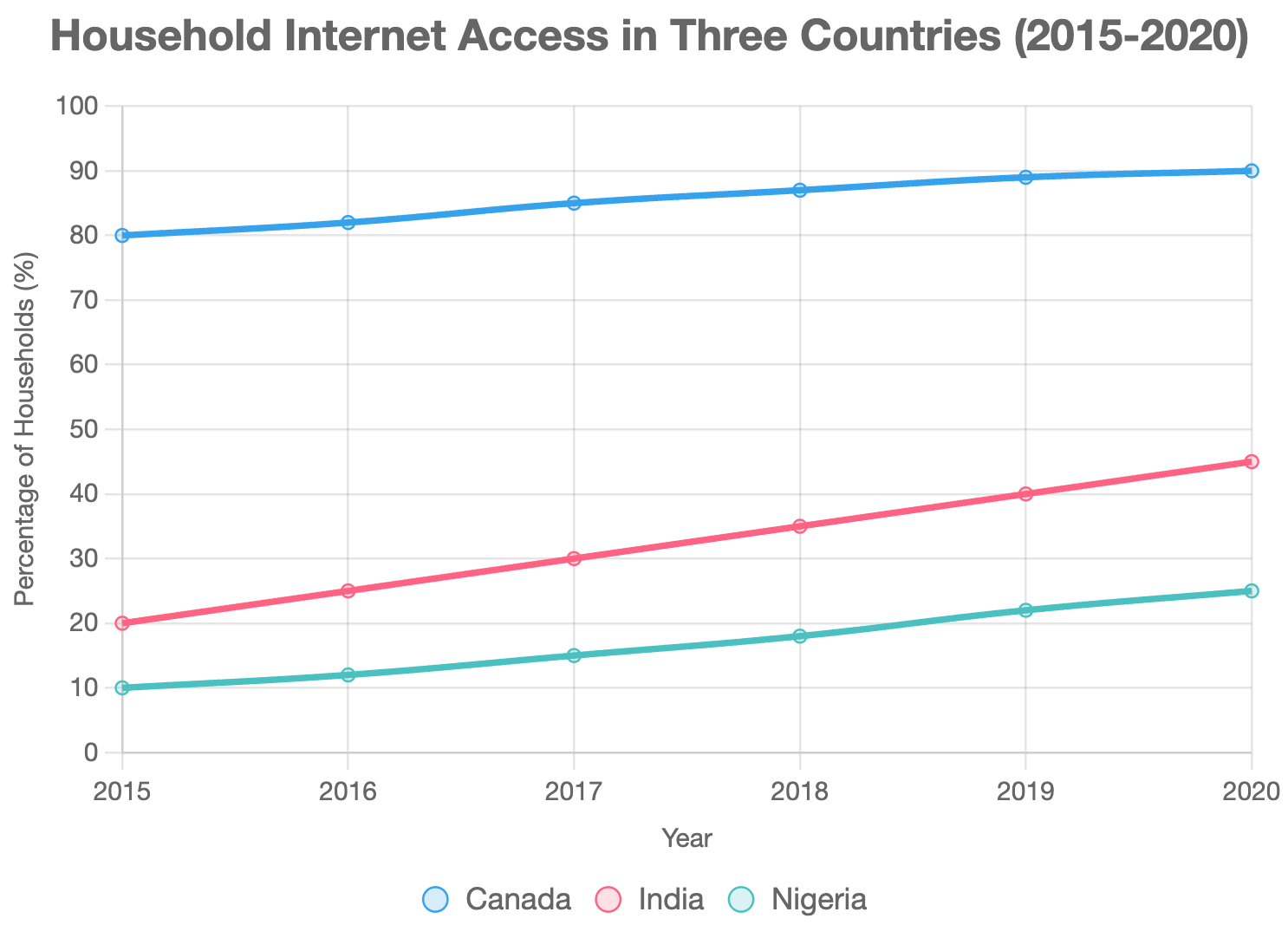
The line graph below shows the percentage of households with internet access in three countries (Canada, India, and Nigeria) from 2015 to 2020.

task1

The line graph illustrates the proportion of households with internet access in Canada, India, and Nigeria from 2015 to 2020. Overall, all three countries experienced an upward trend in internet access, with Canada maintaining the highest levels, while Nigeria had the lowest throughout the period.

In 2015, Canada had the highest percentage of households with internet access at 80%, rising steadily to 90% by 2020. India started at 20% in 2015 and saw a consistent increase, reaching 45% by 2020. Nigeria, with the lowest initial access at 10%, grew to 25% over the same period.

Canada's internet penetration was significantly higher than that of India and Nigeria, reflecting its advanced infrastructure. India's growth rate was notable, doubling its percentage over five years, indicating rapid digital expansion. Nigeria, while showing progress, remained considerably behind, likely due to economic and infrastructural constraints. These trends highlight disparities in technological development across the countries, with Canada leading and Nigeria lagging.

Task2

The increasing use of social media among young people has raised concerns about its impact on mental health. What are the main causes of this issue, and what measures can be taken to address it?

The growing prevalence of social media among young people has sparked concerns about its detrimental effects on mental health. This essay will explore the primary causes of this issue and propose effective solutions to mitigate its impact.

One major cause is the pressure to conform to idealized online personas. Social media platforms often showcase curated lifestyles, leading to comparison and feelings of inadequacy among young users. For instance, exposure to influencers' polished images can trigger low self-esteem or anxiety. Additionally, excessive screen time, particularly late at night, disrupts sleep patterns, exacerbating stress and metal fatigue. Cyberbullying is another significant factor, as negative comments or harassment online can profoundly affect emotional well-being, especially among adolescents.

To address these issues, educational initiatives should be implemented to promote digital literacy. Schools could teach young people to critically evaluate social media content and recognize its artificial nature, reducing the urge to compare. For example, programs in Australia have successfully integrated media literacy into curricula, fostering healthier online habits. Governments and platforms should also enforce stricter anti-cyberbullying measures, such as real-time moderation and reporting systems. Furthermore, parents and schools can encourage balanced screen time by promoting offline activities, such as sports or hobbies, to enhance mental resilience.

In conclusion, social media's impact on young people's mental health stems from comparison, excessive use, and cyberbullying. By fostering digital literacy, strengthening platform regulations, and encouraging offline engagement, societies can alleviate these effects, ensuring young people maintain healthier relationships with social media.

Vocabulary & Expressions

Term/ExpressionDefinitionSimpler Paraphrase
prominenceThe state of being important or noticeableImportance
conformTo comply with rules or standardsFollow
detrimentalCausing harm or damageHarmful
exacerbatingMaking a problem or situation worseWorsening
resilienceThe ability to recover quickly from difficultiesStrength
alleviateTo make something less severe or intenseReduce
penetrationThe extent to which something is adopted or spreadSpread
disparitiesSignificant differences or inequalitiesGaps

AI의 역사

· 약 2분

A rational agent is one that acts so as to achieve the best outcome or, when there is uncertainty, the best expected outcome

The inception of artificial intelligence (1943–1956)

  • Warren McCulloch와 Walter Pitts (1943): 인공 신경망(artificial neuron model)을 제안.
  • Alan Turing (1950): "Computing Machinery and Intelligence" 논문에서 튜링 테스트(Turing Test)라는 개념을 제안.
  • John McCarthy, Marvin Minsky, Nathaniel Rochester, Claude Shannon이 1956년 Dartmouth workshop을 개최, 여기서 "artificial intelligence"라는 용어가 공식적으로 등장.
  • 주요 성과
    • Logic Theorist (Newell & Simon): 최초의 ‘논리 추론’ 프로그램.
    • General Problem Solver (GPS): 범용 문제 해결 시스템.

Early enthusiasm, great expectations (1952–1969)

  • AI 연구자들은 symbolic reasoning과 search를 이용해 문제를 해결하려 시도.
  • Perceptron(Rosenblatt, 1957): 초기 신경망 모델로, 패턴 인식에 사용.
  • 대표적인 시스템
    • Samuel의 체커 프로그램: 컴퓨터가 스스로 학습해서 체커를 둘 수 있도록 설계.
    • ELIZA: 자연어 처리를 흉내 낸 최초의 대화형 프로그램.

A dose of reality (1966–1973)

  • 자동 번역(Machine Translation)의 한계가 드러남: 1966년 ALPAC 보고서가 정부 자금 축소로 이어짐.
  • Perceptron의 한계(Minsky & Papert, 1969): XOR 문제 등, 단층 신경망으로는 복잡한 문제를 해결할 수 없다는 것을 증명.
  • 연구의 중심이 "toy domains"(작은 문제 영역)로 한정.

Expert systems (1969–1986)

  • Weak methods(약한 방법): 범용성은 있으나 복잡한 문제엔 비효율적.
  • Domain-specific knowledge(도메인 특화 지식): 전문가의 경험을 수천 개의 규칙으로 시스템에 구현.
  • DENDRAL: 질량 분석 데이터를 바탕으로 분자 구조를 추론하는 시스템. Knowledge-intensive system의 대표 사례.
  • MYCIN: 450여 개의 규칙로 혈액 감염을 진단. certainty factors(불확실성 계산) 개념 도입.
  • R1(XCON): Digital Equipment Corporation의 컴퓨터 시스템 주문을 자동으로 구성.
  • 이 시기 Expert system의 상업적 성공: 대기업들이 적극 도입.
  • Frame, Semantic Networks, Description Logics 등 다양한 representation and reasoning tools의 등장.
  • Prolog와 PLANNER와 같은 논리 프로그래밍 언어의 활용.
  • "Fifth Generation" project(일본, 1981): 병렬형 인공지능 컴퓨터 연구 대형 프로젝트(성공적 성과는 제한적).
  • 미국, 유럽도 대응 프로젝트 진행.

The return of neural networks and machine learning (1986–present)

  • Back-propagation 알고리즘이 재발견되며 심층 신경망(deep neural networks)의 부흥이 시작됨.
  • Big Data와 컴퓨팅 파워의 증가로 deep learning이 현실의 다양한 문제를 해결하는 데 쓰이기 시작.
  • 2010년대 Yann LeCun, Geoffrey Hinton, Yoshua Bengio 등이 딥러닝 혁신을 주도.

IELTS Transcription @010

· 약 3분

Task1

The pie charts below show the distribution of household expenditure in four categories (housing, food, transport, and other) in a country in 2015 and 2020.

2015 (%)2020 (%)
task1task1

The pie charts illustrate the distribution of household expenditure across four categories-housing, food, transport, and other-in a country in 2015 and 2020. Overall, there was a noticeable shift in spending patterns, with food and transport increasing in proportion while housing and other expenses declined.

In 2015, housing accounted for the largest share at 35% followed by food at 25%, and both transport and other categories at 20% each. By 2020, food expenditure rose to 30%, equalling housing, which decreased to 30%. Transport expenditure increased to 25%, while the "other" category saw a reduction to 15%.

The most significant change was the 5-percentage-point increase in food expenditure, reflecting its growing importance in household budgets. Transport also gained prominence, rising by 5 percentage points, whereas housing lost its dominant position. The decline in the "other" category suggests a reallocation of funds toward essential expenses, likely driven by economic or lifestyle changes over the five-year period.

Task2

Some people believe that governments should invest heavily in public transportation to reduce traffic congestion and pollution. Others argue that improving road infrastructure is a more effective solution. Discuss both views and give your own opinion.

The debate over whether governments should prioritize public transportation or road infrastructure to address traffic congestion and pollution is multifaceted. Both approaches have merit, but their effectiveness depends on context. This essay will discuss both perspectives and present my own view.

Advocates of public transportation argue that it offers a sustainable solution to urban challenges. Efficient systems like buses, trains, and subways can transport large numbers of people, reducing the number of private vehicles on roads. For instance, cities like Tokyo have invested in extensive metro systems, significantly lowering per-capita emissions and easing traffic flow. Public transport is also more accessible to lower-income groups, promoting social equity. Furthermore, modern electric buses and trains can substantially reduce pollution, aligning with environmental goals.

Conversely, proponents of road infrastructure improvements argue that better roads enhance traffic efficiency. Widening highways, building flyovers, or implementing smart traffic systems can alleviate bottlenecks, as seen in cities like Dubai, where advanced road networks reduce travel times. Critics of public transport investments note that such projects are costly and time-consuming, and may not address immediate congestion issues in rapidly growing urban areas.

In my opinion, investing in public transportation is more effective in the long term. It addresses both congestion and pollution while promoting sustainable urban development. However, strategic road improvements can complement these efforts, particularly in areas with limited public transport infrastructure. A balanced approach, prioritizing public transport with targeted road enhancements, offers the most holistic solution to urban mobility challenges.

IELTS Transcription +009

· 약 3분

Task1

The table below shows the percentage of households with internet access in four regions for the years 2010, 2015 and 2020, and the overall change between 2010 and 2020.

Region2010 (%)2015 (%)2020 (%)Change (%)
North America658092+27
Europe587589+31
Asia426075+33
Sub-Saharan Africa153048+33

The table compares household internet access rates in four regions-North America, Europe, Asia and Sub-Saharan Africa across 2010, 2015 and 2020, and shows the percentage-point change over the decade. Overall, all regions experienced substantial increases, with Asis and Sub-Saharan Africa recording the largest gains.

In 2010, North America led with 65% access, rising to 92% by 2020, a change of +27 points. Europe followed, increasing from 58% to 89% (+31). Asia saw access climb from 42% to 75% (+33), matching Sub-Saharan Africa's growth, which rose from a low base of 15% to 48% (+33). By 2020, the gap between the highest and lowest regions had narrowed from 50 points in 2010 to 44 points.

The data indicates that developing regions made the most rapid progress, likely due to infrastructure investments and policy initiatives promoting connectivity. In contrast, advanced regions like North America and Europe showed more modest absolute increases, as they began from higher starting points. In summary, while all regions improved, the greatest relative expansion occurred where initial access was lowest.

Task2

Some people believe that learning computer programming should be a compulsory part of the school curriculum. To what extent do you agree or disagree?

While computer programming offers clear benefits, I disagree that it should be compulsory for all school students. Mandating coding risks overloading curricula, may not suit every leaner, and could divert attention from equally vital subjects.

Firstly, a one-size-fits-all approach can overwhelm students whose strengths lie elsewhere. Not every child has an aptitude for abstract, logical thinking required in programming. Forcing all pupils to learn to code may discourage those who would excel in areas such as the arts, humanities or languages, thereby stifling diverse talents.

Secondly, curriculum time is finite. Introducing compulsory coding would necessitate reducing hours for other core subjects-such as literature, history or the natural sciences-which cultivate critical cultural awareness and scientific literacy. These disciplines are essential for fostering well-rounded individuals and informed citizens.

Finally, effective programming instruction requires skilled teachers and up-to-date resources. Many schools, particularly in under-resourced areas, lack qualified computer science educators and sufficient technological infrastructure. Compulsory coding risks creating superficial, checkbox-style lessons that fail to develop genuine proficiency.

In conclusion, although programming is a valuable skill in our digital age, it should remain an optional subject. Allowing students to choose based on their interests and strengths preserves curriculum balance and respects individual aptitudes, leading to better educational outcomes overall.

Vocabulary & Expressions

Term/ExpressionDefinitionSimpler Paraphrase
A one-size-fits-allDesigned to apply universally without variationSame for everyone
Abstract thinkingThinking about ideas and concepts rather than concrete factsThinking about ideas
StiflingPreventing growth or developmentHolding back
FiniteHaving limits or an endLimited
Cultural awarenessUnderstanding and appreciation of different culturesKnowing about other cultures
Up-to-dateModern; using the latest information or technologyCurrent
Checkbox-style lessonsSuperficial teaching that merely fulfils a requirementLessons done just to tick a box
Educational outcomesThe results or achievements of learningLearning results

IELTS Transcription +008

· 약 3분

Task1

The bar chart below shows the average number of hours per day different age groups spent on screen-based devices in 2024.

task1

The bar chart presents data on the average daily screen time across six age groups in 2024. It is evident that younger individuals spent significantly more time on screens than older age groups.

The highest screen usage was recorded among those aged 10-19, who spent an average of 7.5 hours daily. This figure gradually declined with age: 20-29-year-olds averaged 6.8 hours, while 30-39-year-olds spent around 5.4 hours. The 40-49 age group logged 4.1 hours, and screen time dropped further to 3.2 hours for those aged 50-59. The lowest figure was among those aged 60 and above, with just 2 hours per day.

The data indicates a clear inverse relationship between age and screen usage. Younger age groups particularly teenagers and young adults, are the most active digital users, like due to social media, entertainment, and education-related activities. In contrast, older generations tend to have less engagement with digital devices.

In summary, screen time is strongly age-dependent, with usage decreasing steadily as age increases.

Task2

Some people believe that the internet has brought people closer together, while others think that it has made people more isolated. Discuss both views and give your own opinion.

The internet is often hailed as a tool that connects people across the globe. However, while some argue that it fosters closeness, others believe it has led to greater social isolation. Both perspectives hold merit, but I personally believe the internet has overall brought people closer together.

Proponents of the internet's social benefits point to the ease of communication. Video calls, messaging apps, and social media allow people to stay connected with family and friends regardless of distance. In addition, online communities can offer support for individuals with shared interests or rare conditions, especially those who might struggle with in-person interactions.

Conversely, critics argue that digital communication has replaced face-to-face interaction. They claim that excessive use of social media may result in superficial relationships, reduced empathy, and a decline in real-world social skills. Furthermore, people who spend long hours online may neglect relationships in their immediate environment.

In my opinion, the key lies in how the internet is used. When leveraged wisely, it enhances human connection by bridging geographical gaps and providing new forms of interaction. However, overreliance on online communication at the expense of physical presence can lead to emotional distance.

In conclusion, while the internet can potentially isolate individuals, its overall effect has been to bring people closer-provided it is used to complement, rather than replace, real-life relationships.

Vocabulary & Expressions

Term / ExpressionDefinitionSimpler Paraphrase
Inverse relationshipWhen one value increases as the other decreasesOne goes up, the other goes down
Digital usersPeople who frequently use digital devices or the internetPeople who use screens or the web
Hailed asPraised or described asCalled or celebrated as
Superficial relationshipsConnections lacking depth or sincerityShallow friendships
LeverageTo use something to maximum advantageMake good use of something
At the expense ofCausing harm to something in order to benefit anotherWhile hurting something else
Emotional distanceLack of emotional closeness between peopleFeeling far from someone emotionally

IELTS Transcription +007

· 약 3분

Task1

The line graph shows the percentage of the population using renewable energy between 2010 and 2020.

task1

The line graph illustrates the proportion of the population using renewable energy over an 11-year period from 2010 to 2020. Overall, there was a consistent upward trend throughout the decade.

In 2010, only 12% of the population used renewable energy sources. This figure rose steadily, reaching 18% by 2013 and surpassing 30% by 2017. The increase continued more sharply from 2018 onwards, culminating in 40% usage by 2020. The largest annual growth occurred between 2019 and 2010.

The graph suggests that public adoption of renewable energy gained momentum, likely due to technological improvements, government incentives, and increased environmental awareness. By the end of the period, more than triple the number of people used clean energy compared to 2010, highlighting a substantial behavioral shift in energy consumption.

Task2

Some people believe that online education is as effective as traditional classroom learning. To what extent do you agree or disagree?

With the rise of digital platforms, online education has gained significant popularity. While some argue that it matches traditional learning in quality, other remain skeptical. I believe that while online learning offers valuable flexibility, it is not yet a full substitute for classroom-based education.

One major strength of online education is accessibility. Students from remote or underserved areas can access high-quality resources without the need to travel. In addition, digital platforms often allow learners to progress at their own pace and review material repeatedly, which can enhance understanding.

However, traditional classrooms offer vital social and interactive components that online platforms often lack. Real-time discussions, immediate feedback from teachers, and group activities foster deeper engagement and critical thinking. Furthermore, hands-on subjects such as science or art often require physical presence and equipment, which are difficult to replicate virtually.

In my opinion, a blended model that incorporates both formats is the most effective. Online tools cna supplement in-person instruction, offering convenience while maintaining academic rigor and interpersonal interaction.

In conclusion, although online education has considerable advantages, it cannot entirely replace the rich, dynamic experience of traditional classrooms. A hybrid approach is likely to yield the best educational outcomes.

Vocabulary & Expressions

Term / ExpressionDefinitionSimpler Paraphrase
Consistent upward trendA steady and ongoing increaseKeeps going up
CulminatingReaching the highest pointEnding at a peak
Gained momentumIncreased in speed or importanceGrew faster
Blended modelA mix of online and in-person learningCombining both ways
Hands-on subjectsCourses that involve physical activity or toolsPractical subjects
Academic rigorHigh standards and thorough learningSerious and deep study
SubstituteSomething that replaces anotherA replacement