CNN 011
· 약 4분
Sequence
- has a lot of context to predict the next behavior
Sequence modelling types
- One to One Binary classification
X -> Y'- Will it rain today? Yes/No
- Many to One Sentiment Analysis
X1, X2, X3, ... -> Y'- Is this review positive or negative?
- One to Many Image Captioning
X -> Y1, Y2, Y3, ...- Image: A Women is throwing a frisbee in the park
- Many to Many Q&A with LLMs, Language translations
X1, X2, X3, ... -> Y1, Y2, Y3, ...- Q: Hey, Siri How's the weather today? A: It's sunny and warm outside.
RNN
Recurrent Neural Network
-
- : output at time t
- : input at time t
- : Past momery
Sequence Modelling
- Support for Variable-Length input
- Has Temploral Dependency (Long, Short-term)
- Preserve the information order
- Share parameters across sequence
Attention
- Why
- RNNs process sequences one step at a time
- Long sentences lead to Long-term memory loss
- Important words can be hidden in long dependencies
- Attention helps to focus on relevant parts of the input
- For each output word, atention decides which input word is most important
- Computes a weighted sum of all input vectors
- Higher weights words are more important
Transformer
- Self-Attention is the foundation for Transformers architecture
- Entire sequence is processed in parallel
- Has Encoder and Decoder block
- Stack of Layers with Self Attention and Feed Forward Neural Network
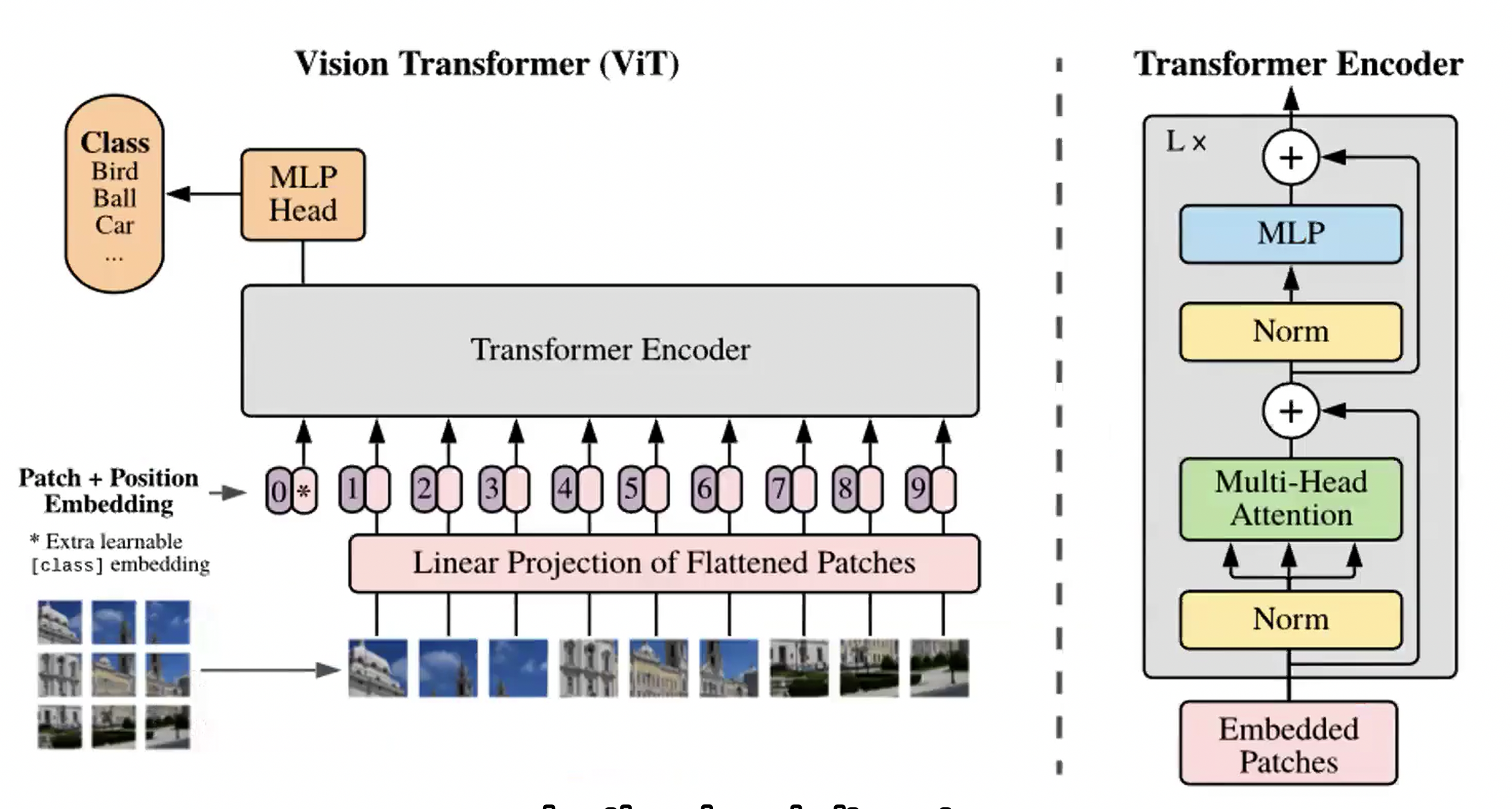
Vision Image Transformer (ViT)
- Vision transformer have extensive application in all computer vision tasks
- ViT looks at images, like how lanauge model looks at words
- Image are represented as sequence of patches
Steps to use ViT
- Split an image into patches
- Flatten the patches
- Produce lower-dimensional linear embeddings from the flattened patches
- Add positional embeddings
- Feed the sequence as input to a standard transformer encoder
- Pretrain the model with image labels (fully supervised on a huge dataset)
- Finetune on the downstream dataset for image classification
CNNs vs Vision Transformer (ViT)
| Key Aspects | CNNs | ViT |
|---|---|---|
| Input Handling | Processes the entire image using filters (kernels) | Splits image into fixed-size patches (like tokens) |
| Local vs. Global | Focuses on local patterns first (edges, textures) | Uses global self-attention to relate all patches |
| Architecture | Hierarchical (convs -> pools -> deeper features) | Flat transformer encoder stack |
| Training Data Need | Works well with limited data | Needs lots of data or pretraining |
| Computation | Efficient with low-res inputs | Computationally heavier, especially on large images |
| Parallelism | Limited; uses sequential feature stacking | High; patch processing is highly parallelizable |
RF-DETR
Roboflow Detection Transformer
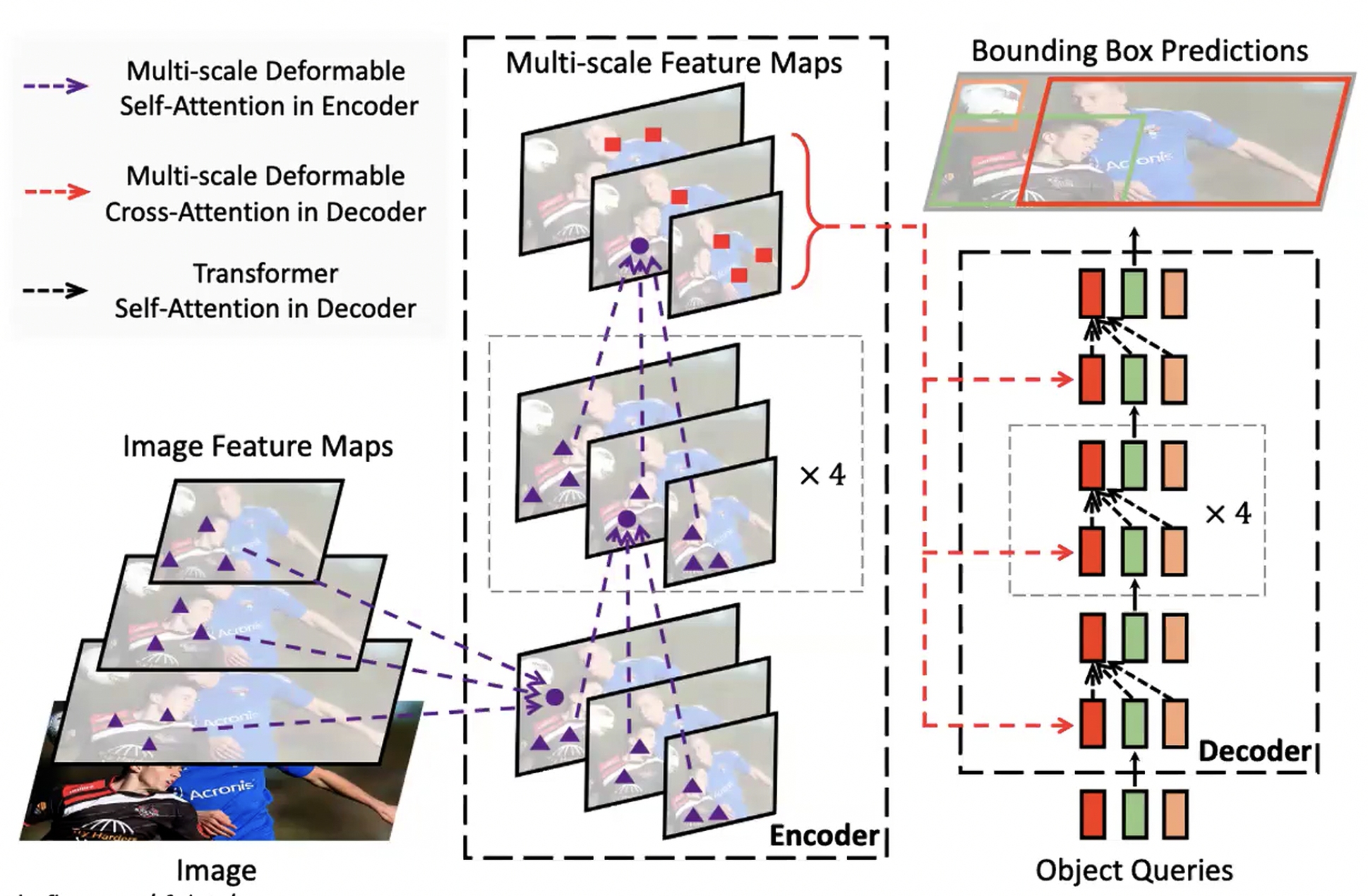
- Object detection techniques using Transformers
- An improvement over the original DETR (Detection Transformer) model
- DETR looks at everything globally but miss small things.
- RF-DETR looks globally and understands the relationships between things.
- First real-time Transformer-based object detection architecture
- Outperforms all object detection models, 60+% mAP on COCO dataset
Diffusion Models
- Generate new data samples (images, audio, text) that is similar to a training dataset by learning to reverse a gradual noise process
- Forward Diffusion
- Add noise gradually to the original image for many steps
- Iterate until the image becomes pure noise
- Gaussian noise used (no learning)
- Reverse Diffusion
- Denosing, model is trained to predict and reverse this noise
- Use the prediction to denoise the image
- Given a noisy image, it predicts a slightly less noisy image version
- After several steps, it reconstructs a clean and new image from pure noise
Steps to train a diffusion model
- Start with real data
- Add noise step by step, until the image becomes pure noise
- Train a model to reverse this process, denoising to recover the original image
- Once trained, the model can start from pure noise and generate new and realistic samples
Applications of Diffusion Models
- Given a lof of sprite sample images
- Can generate New sprite images
- New image generation from image input