Mitigating Hallucinations on Object Attributes Review
· 약 4분
Overview
- Introduces a HoOA benchmark that isolates hallucinations on object attributes (color, shape) from existence/relationship errors.
- Proposes MIAVLM: leverages multiview images (generated from a single image’s 3D representation) and a Multiview Attributes Perceiver (MAP) to make fusion order-invariant.
- Adds negative instructions during tuning to counter LVLMs’ tendency to answer "Yes".
- Results: best HoOA metric (0.775 / 0.787) with fastest inference (0.071 / 0.105 s). "9in1" tiling is ineffective; separate multiview inputs help.
- Training: LM loss, Adam (lr=0.001), cosine annealing, 20 epochs, single NVIDIA 3090.
Hallucinations on Object Attributes (HoOA)
Issues
- HoOA = incorrect attribute descriptions for existing objects (distinct from HoOE/HoOR).
- Root causes analyzed:
- Single-view insufficiency: fine-grained details can be invisible from a single viewpoint.
- Instruction bias: overexposure to positive/affirmative patterns → "Yes" bias.
- Order sensitivity: multi-image inputs change predictions when view order changes.
Mitigation Methods (this paper)
- Multiview prompts: sample views from a single image’s 3D reconstruction to recover missed details.
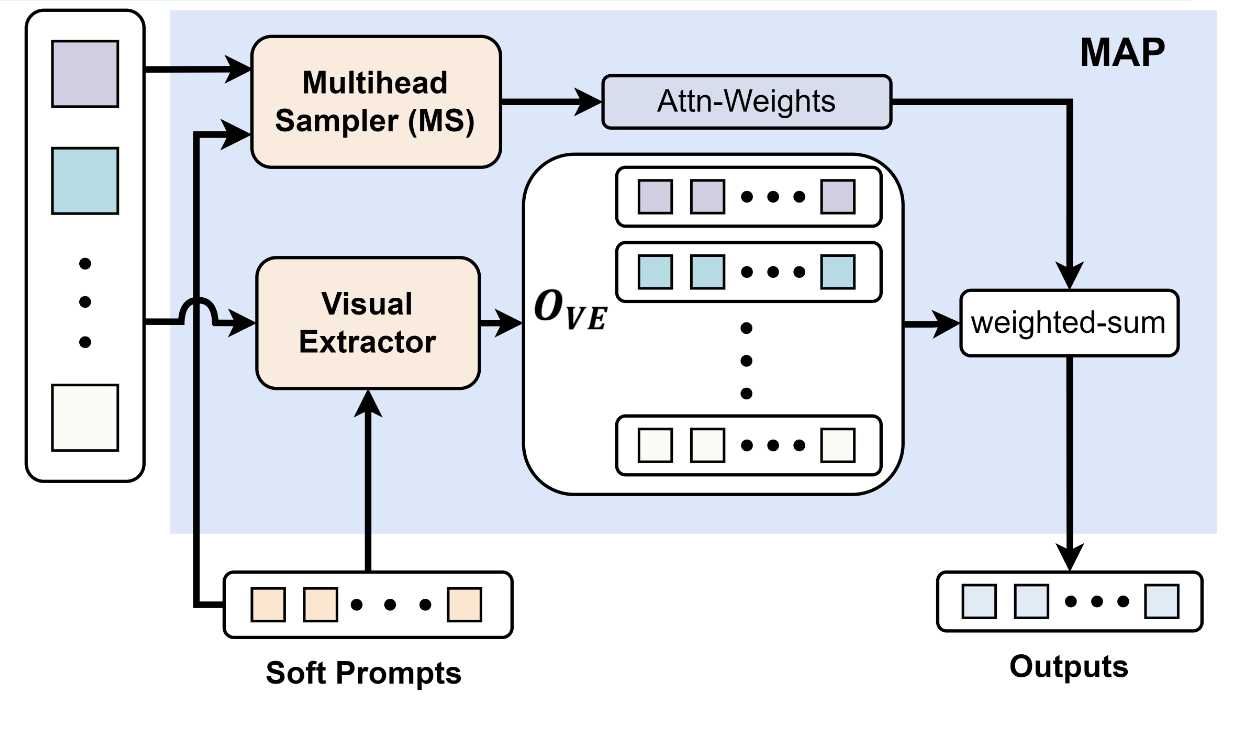
- MAP (order-invariant fusion): learn view weights and fuse per-view features via weighted sum; input order has no effect; supports any number of views.
- Negative instructions: incorporate "No"-answerable questions in tuning to suppress "Yes" bias.
Benchmark (HoOA)
Construction
- Based on CelebAText-HQ; manual attribute descriptions rewritten into Yes/No questions.
- Positive questions → correct answer "Yes".
- Negative questions → attribute flipped/opposite → correct answer "No" (to expose "Yes" bias).
- Scale: 1,430 images, 14,291 positive + 14,291 negative questions.
- Split: 9:1 train:test.
- Metric: average of accuracy on positive and negative questions (balanced HoOA score).
Model: MIAVLM
Visual Extractor (VE)
- 6 stacked Transformer decoder blocks.
- Soft prompts are queries; image embeddings are keys/values.
- Per-view cross-attention computed in parallel (no autoregressive chaining; no assumed order).
- Per-view output:
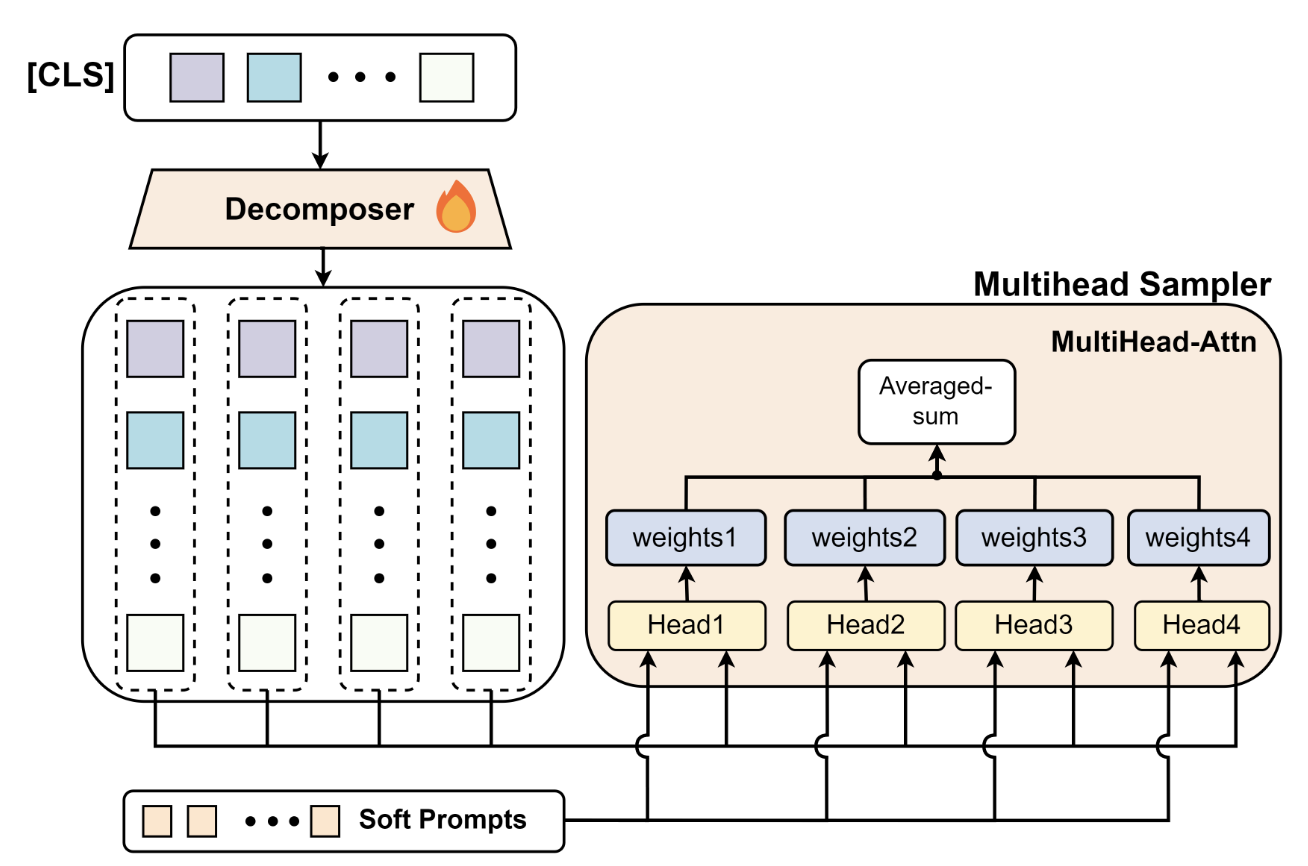
Multihead Sampler (MS)
- Learns view weights for fusion.
- Decomposer (2-layer MLP) maps each view’s to tokens .
- For each token/head : compute attention scores vs. → mean over prompt tokens → .
- Average across heads:
MAP (Multiview Attributes Perceiver)
- Order-invariant weighted fusion:
- Properties: supports any number of views; permutation-invariant to input order.
- By learning weights for each view, MAP highlights informative perspectives and suppresses less useful ones, ensuring consistent predictions even when the view order changes. This directly addresses the input-order sensitivity observed in baselines such as OpenFlamingo.
Benchmarks
Baselines & Input Modes
- Baselines: BLIP3, OpenFlamingo (4 variants), OPERA, Idefics2, LLaVA-UHD.
- Two input modes:
- Original image only.
- Original + 8 generated views.
- Models that accept only one image use 9in1 tiling (nine images stitched into one).
Main Results
- MIAVLM:
- HoOA metric: 0.775 / 0.787 (modes 1 / 2)
- Positive accuracy: 0.752 / 0.762
- Negative accuracy: 0.797 / 0.812
- Inference time: 0.071 / 0.105 s (fastest)
- 9in1 tiling did not improve results (likely harder to interpret).
- Nine separate multiview images generally improved performance.
Ablations
- Negative instructions: boost negative-question accuracy but slightly reduce positive-question accuracy; overall HoOA increases (approx. 0.665 → 0.787).
- Input-order sensitivity:
- MIAVLM is order-invariant
- OpenFlamingos accuracy varies when shuffling view order.
Limitations & Notes
- Trade-off from negative instructions (negatives ↑, positives ↓).
- Effectiveness depends on the quality of generated views.
Insights
- This approach seems especially suitable for perception, where multiple scene views may arrive in arbitrary order, ensuring consistent attribute recognition.
Ref
- Tan, Z., Li, Y., Meng, S., Yuan, X., Li, W., Mo, T., Wang, B., & Chu, X. (2025, 6–11 April 2025). Mitigating Hallucinations on Object Attributes using Multiview Images and Negative Instructions. ICASSP 2025 - 2025 IEEE International Conference on Acoustics, Speech and Signal Processing (ICASSP).